After 15 Years, Apple Is Getting a New CEO — And Most People Have Never Heard of Him
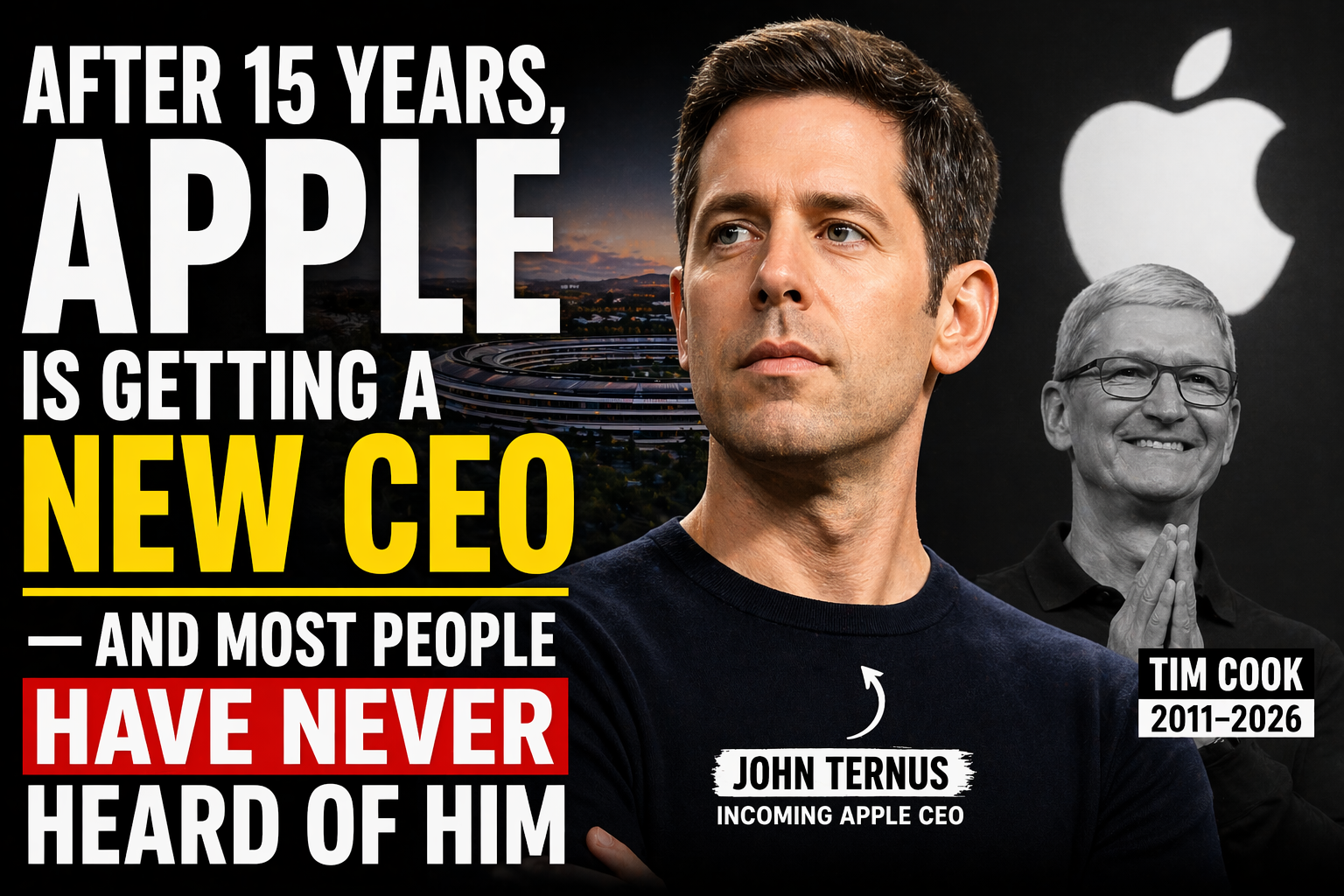
John Ternus is Apple's incoming CEO, succeeding Tim Cook after 25 years at the company. Here's who he is, what he built, and what his appointment signals about Apple's next decade.
- John Ternus is Apple's incoming CEO, succeeding Tim Cook
- Has spent 25 years at Apple — joined in 2001
- Currently serves as SVP of Hardware Engineering
- Led development of Apple Silicon, Vision Pro, and AirPods
- Approximately 15 years younger than Tim Cook — suggesting long runway
After 15 Years, Apple Is Getting a New CEO — And Most People Have Never Heard of Him
When Steve Jobs handed the reins to Tim Cook in 2011, the world knew who Tim Cook was. He had been Apple's COO for years, highly visible in industry circles, a familiar presence in earnings calls and supply chain discussions. The transition felt legible, even if it felt enormous.
The transition to John Ternus feels different.
Ternus is not unknown inside Apple. Inside Apple, he is considered one of the most important people in the building — the executive who oversaw the hardware engineering behind the products that define the company. But outside Apple, he has lived with deliberate invisibility. No keynote celebrity moments. No punchy media interviews. No public persona constructed for external consumption.
The person who will lead one of the most valuable companies in human history into its next chapter has spent the last two decades working hard to stay out of headlines. That, as it turns out, tells you a great deal about the kind of CEO he is likely to be.
Who Is John Ternus?
John Ternus currently serves as Apple's Senior Vice President of Hardware Engineering. In practice, that title means he is responsible for all of the physical products that generate the majority of Apple's revenue — the iPhone, the MacBook line, the Apple Watch, and AirPods.
This is not a coordination role or a managerial abstraction. It is a deeply technical leadership position that requires understanding the engineering constraints, manufacturing requirements, supply chain realities, and design considerations of some of the most complex consumer electronics ever produced. Ternus has held this responsibility and, by Apple's standards of performance, executed it with consistent excellence.
His transition from the person who runs hardware engineering to the person who runs Apple represents a deliberate choice by the board about what Apple needs in its next phase — and that choice is worth examining carefully.
Twenty-Five Years in the Making
John Ternus joined Apple in 2001, one year after graduating from the University of Pennsylvania. He was not a business school recruit. He was an engineering-minded person who wanted to work on real products, and Apple in 2001 — in the early years of Steve Jobs' return — was building some of the most interesting ones in the industry.
He joined as part of the product design team at a time when Apple was in the early stages of the transformation that would eventually make it the world's most valuable company. The iPod had just launched. The iMac was reshaping what personal computers could look like. The company was rebuilding its identity around the principle that technology and design were not in tension — that the best products were ones where engineering constraints and aesthetic vision were treated as two aspects of a single problem.
Ternus absorbed this philosophy from the beginning. His career progressed steadily — from product design contributor to VP to SVP — not through high-visibility political maneuvering but through the consistent production of results. Apple rewards this kind of trajectory. The company has always been somewhat suspicious of executives who optimize for visibility and deeply respectful of those who optimize for product quality.
By the time he reached the SVP level, Ternus was known throughout Apple as someone who combined genuine engineering depth with the management capability to run large, complex teams working on multiple simultaneous projects under extreme time pressure.
The Leadership Transition: Why Now, Why Him
Tim Cook has been one of the most consequential CEOs in business history. The numbers are straightforward: under his leadership, Apple's market capitalization grew from approximately $350 billion to well over $3 trillion. He turned Apple into a services company while maintaining its hardware excellence. He navigated supply chains, geopolitical tensions, regulatory scrutiny, and the constant pressure of following Steve Jobs in a way that virtually no one expected him to manage as effectively as he did.
But Tim Cook is in his sixties. And John Ternus is approximately fifteen years younger.
That age differential is not incidental — it is strategic. Boards of companies the size and complexity of Apple do not make succession decisions casually. The selection of Ternus signals an expectation that the next CEO will have a long runway — potentially two decades of leadership. The person who leads Apple through the 2020s and 2030s needs to be someone who can grow with the challenges of that period, not someone who is already in the later stages of their career.
Apple has historically prized leadership stability. Jobs ran the company for over a decade after his return. Cook has now led it for well over a decade. Selecting a relatively young SVP with deep institutional knowledge and a demonstrated track record of execution continues this pattern of betting on people who will be in position for the long term.
What He Actually Built
The most effective way to understand what John Ternus brings to the CEO role is to look at what he has overseen as SVP of Hardware Engineering. The list is not a collection of minor refinements — it is a record of some of the most consequential hardware decisions Apple has made in the last decade.
The Apple Silicon Transition
When Apple announced in 2020 that it would transition the entire Mac line from Intel processors to its own Apple Silicon chips, the industry was skeptical. Processor transitions are extraordinarily complex engineering challenges. Apple had attempted a similar transition before — from PowerPC to Intel — and while it eventually succeeded, it was a difficult period for the company.
The Apple Silicon transition, by contrast, went faster and more smoothly than almost anyone had predicted. The M1 chip performed beyond most benchmarks. The transition from announcement to widespread adoption happened in roughly two years. The M-series chips delivered performance and efficiency improvements that reshaped the laptop and desktop market's assumptions about what was possible.
Ternus was the executive responsible for the hardware engineering side of this transition. It was executed on schedule, at quality, and with results that exceeded industry expectations.
Vision Pro
Vision Pro is the most ambitious hardware product Apple has attempted since the original iPhone. A spatial computing headset that integrates high-resolution displays, an array of cameras, advanced sensors, and custom chips into a form factor that Apple expects to carry for years — and potentially decades — as the company's vision of computing's next form factor.
The engineering challenges involved in Vision Pro are considerable enough that getting the product to market in any form represented a significant achievement. The quality of the first generation — its optics, its processing capability, its integration with the rest of Apple's ecosystem — reflects the kind of hardware engineering discipline that Ternus has built into his organization.
AirPods and Apple Watch
Before Silicon and Vision Pro, Ternus oversaw the engineering execution of AirPods and Apple Watch — both of which required solving significant miniaturization, battery life, and wireless communication challenges. AirPods, in particular, became one of Apple's most successful product categories, generating billions of dollars in annual revenue from what was initially a widely mocked design choice.
Leadership Style: The Opposite of Charisma
There is a prevailing assumption in the tech industry that effective CEOs need to be charismatic public figures — people who can generate enthusiasm at developer conferences, perform credibly in media interviews, and project a compelling vision to an audience of millions.
John Ternus challenges this assumption by example.
People who have worked with him consistently describe a leader defined by humility rather than ego, by attention to detail rather than big-picture posturing, and by a genuine interest in getting things right rather than being seen to get things right. He asks questions. He listens. He pushes back on conclusions that are not supported by evidence, and he is willing to be pushed back on in return.
This orientation — sometimes described as a craftsmanship mindset — traces its roots to the philosophy that Steve Jobs embedded in Apple's culture. Jobs believed that the quality of what you build is the only thing that ultimately matters, and that leaders who do not understand the details of what they are building cannot effectively lead the people who do understand them. Ternus appears to have internalized this belief deeply.
His low public profile is not shyness or strategic media avoidance — it is a reflection of where he genuinely believes his attention should be directed. Inside the products, not outside in the press narrative. This is a particular kind of leadership orientation, and it is one that Apple's culture is well-designed to support.
The Personal Dimension
Before Apple, Ternus built a feeding arm assistive technology project as part of his university work — an early demonstration of an engineering mindset oriented toward solving real human problems rather than pursuing technical sophistication for its own sake. He was also a competitive swimmer, which correlates with the kind of disciplined, process-oriented approach to improvement that characterizes his professional reputation.
These are small details, but they sketch a consistent picture: someone who has always been more interested in what he can build and improve than in the recognition that comes from having built it. For the role of CEO of Apple — where the pressure to perform publicly will be enormous and the temptation to optimize for optics will be constant — this orientation toward substance over appearance is an asset.
The Challenges He Inherits
Ternus is inheriting Apple at a moment of genuine strategic complexity. The company is extraordinarily successful by almost any financial measure. But the landscape around it is shifting in ways that demand responses that go beyond hardware excellence.
The AI Race
Apple's AI capabilities, as represented by Siri and the broader Apple Intelligence initiative, are widely considered to lag behind competitors. Google, Microsoft, and Anthropic have shipped AI products that feel qualitatively more capable than Apple's current offerings in many contexts. For a company that has built its identity around delivering the best user experience in its product categories, falling behind in AI — which is increasingly central to what a smartphone, a laptop, or a personal computing device can do — is a strategic problem that requires urgent and effective response.
Ternus comes from the hardware side, which is where Apple is strongest. The challenge he faces in AI is primarily a software and model capability challenge. Whether he can attract, retain, and effectively direct the kind of AI talent required to close this gap — while maintaining the hardware differentiation that Apple's premium pricing depends on — is the central strategic question of his early tenure.
Vision Pro's Future
Vision Pro launched to genuine critical respect but limited commercial adoption. The product that Ternus helped shepherd to market is now a product he will need to decide the long-term trajectory for as CEO. Does Apple invest in making Vision Pro more accessible — lower price, mainstream market — or does it treat spatial computing as a long-game technology that will take a decade to find its mass market? This is one of the most consequential product strategy decisions he will need to make.
The Transition from Product Leader to Strategic CEO
The skills that make an exceptional SVP of Hardware Engineering are related to, but not identical to, the skills required to run a company of Apple's scope. Ternus will need to engage more directly with investors, regulators, geopolitical relationships, and the media than his previous role required. He will need to develop and communicate a vision that extends beyond hardware engineering excellence to encompass Apple's entire competitive position in a rapidly evolving technology landscape.
This transition is manageable — Cook himself made a comparable shift from operations executive to strategic CEO — but it requires deliberate attention and development.
What This Choice Signals About Apple
The most important signal in Apple's selection of Ternus is not about Ternus specifically — it is about what Apple's board believes the company needs from its next leader.
They did not choose a software executive. They did not choose an AI researcher. They did not choose a business development veteran or a media-savvy public communicator. They chose the person who has spent twenty-five years understanding Apple's hardware products from the inside and delivering them at the quality level that justifies Apple's premium prices.
This is a bet that Apple's fundamental advantage — the integration of hardware, software, and services in products that feel meaningfully better than the alternatives — remains the right axis of competition. It is a bet that the next decade will be won by the company that can translate AI capabilities and new form factors into products that people actually want to use and are willing to pay for. And it is a bet that the person best positioned to do that is someone who understands the products deeply, not someone who understands strategy abstractly.
Conclusion: Continuity With a Different Kind of Ambition
John Ternus represents a particular kind of leadership choice — one that prioritizes institutional depth over external charisma, product understanding over strategic communication, and long-term execution over short-term narrative management.
Whether that is the right choice for Apple in 2025 and beyond depends significantly on factors that are genuinely uncertain — the pace of AI development, the trajectory of spatial computing, the competitive pressure from Samsung, Google, and Chinese manufacturers, and the regulatory environment across Apple's key markets.
What is certain is that Apple has chosen to bet its next decade on someone who knows its products better than almost anyone alive — who has spent twenty-five years understanding not just what Apple makes but why it makes it that way and how that way of making things creates value that competitors struggle to replicate.
Bold Prediction
Within three years of taking the CEO role, John Ternus will launch a product that redefines a category in the way the original iPhone redefined mobile computing. Not because he is trying to create a legacy moment, but because that is what happens when someone who genuinely understands product craft gets the resources, authority, and time to pursue the right ideas to their logical conclusion. The person who helped build Apple Silicon and Vision Pro has not yet had the freedom to define Apple's trajectory from the top. That freedom, combined with twenty-five years of accumulated knowledge, is a genuinely interesting combination to watch.