OpenAI Just Released GPT-5.5 — And It's Not Just an Upgrade, It's a Step Toward Replacing Apps Entirely
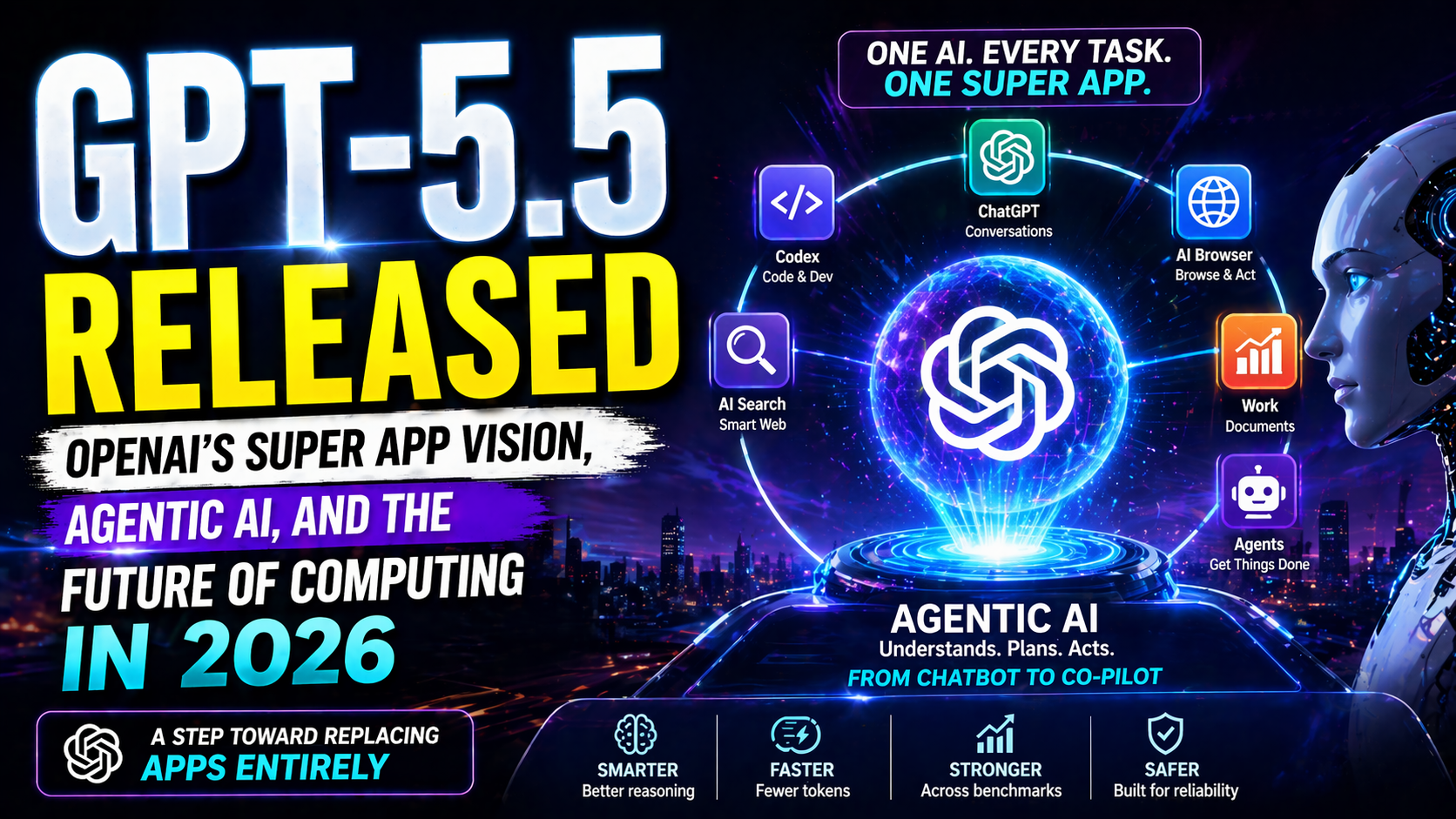
OpenAI released GPT-5.5 — the smartest model yet. But this is not just a model upgrade. It is OpenAI's clearest signal yet that it is building a super app to replace everything. Here is what changed and why it matters.
- OpenAI released GPT-5.5 — described as the smartest and most intuitive model yet
- Major improvements in coding, reasoning, math, and scientific work
- Significantly more agentic — AI that acts on tasks, not just responds to questions
- Available on ChatGPT Plus, Pro, Business, and Enterprise
- Signals OpenAI's shift from model company to AI super app platform
OpenAI Just Released GPT-5.5 — And It Is Not Just an Upgrade. It Is a Step Toward Replacing Apps Entirely.
There is a moment in every major technology transition when the thing being built stops being a better version of what came before and starts being something fundamentally different. The smartphone was not a better phone — it replaced the phone, the camera, the map, the music player, and the alarm clock. The browser was not a better book — it replaced the encyclopedia, the newspaper, the catalogue, and the filing cabinet.
GPT-5.5 might be that moment for AI. Not because of what it can do — though what it can do is genuinely impressive — but because of what it signals about what OpenAI is building toward. The model release is a headline. The strategy behind it is the story.
What OpenAI Actually Announced
OpenAI released GPT-5.5 and described it as its smartest and most intuitive model to date. That kind of language appears in every major model release, so it is worth looking past the marketing phrasing to understand what actually changed.
The release continues a pattern of rapid iteration that has characterized OpenAI's recent development cycle. The time between major model releases has compressed significantly. OpenAI is not waiting to accumulate capability improvements before shipping — it is shipping continuously, with each release building on the last in ways that compound over relatively short time periods.
This release cadence is itself a strategic statement. It communicates to developers, enterprises, and competitors that OpenAI's rate of improvement is not slowing down. It keeps the platform fresh in ways that encourage continued subscription and API usage. And it creates a moving target that competitors must constantly respond to rather than catch up to at their own pace.
GPT-5.5 is available to ChatGPT Plus, Pro, Business, and Enterprise subscribers, with a higher-capability Pro variant available for users who need the maximum performance ceiling the model can offer.
What Actually Improved — The Specifics That Matter
Three areas of improvement stand out as genuinely meaningful rather than incremental refinements.
Efficiency: More Intelligence, Fewer Tokens
GPT-5.5 produces better outputs using fewer tokens than its predecessors. This sounds like a technical detail, but it has direct practical implications. Faster responses. Lower API costs for developers. More content generated within context window limits. For high-volume enterprise use cases, this kind of efficiency improvement translates directly into cost savings at scale.
It also suggests something important about the underlying model architecture — that OpenAI's engineers are getting better at distilling capability rather than simply adding parameters. The path to smarter AI does not necessarily require ever-larger models; it requires better understanding of how intelligence emerges from the training process.
Reasoning: Thinking Through Hard Problems
The reasoning improvements in GPT-5.5 are most visible in domains where getting the right answer requires holding multiple constraints in mind simultaneously — mathematics, formal logic, complex code that must satisfy several competing requirements, and scientific problems where the solution space is large and the verification criteria are precise.
Benchmark performance shows meaningful improvements over GPT-5 and positions GPT-5.5 competitively against Anthropic's Claude and Google's Gemini in the domains where those models have historically been strongest. The competition at the frontier has never been closer, which is itself a remarkable statement about how quickly this space is advancing.
Agentic Behavior: The Most Important Change
The most significant improvement in GPT-5.5 is not captured in any benchmark score. It is the model's increased tendency toward agentic behavior — the ability to break down complex goals into steps, execute those steps in sequence, use tools and external resources appropriately, and adapt the plan when intermediate results require it.
Previous generations of GPT were primarily reactive — excellent at responding to what you asked, less capable of autonomously working through what you needed without being explicitly guided through each step. GPT-5.5 narrows this gap meaningfully. The model is more capable of receiving an open-ended goal and working toward it without requiring continuous hand-holding.
This is not a minor improvement. It is the capability shift that makes AI genuinely useful for workflows rather than just for individual interactions.
What Agentic AI Actually Means — And Why It Changes Everything
The word "agentic" has become so common in AI discussions that it risks losing meaning. Here is a concrete way to understand what actually changed and why it matters.
The original ChatGPT was a chatbot. You asked a question. It answered. The interaction was a single exchange, and the value was in the quality of that single response. This was genuinely useful — but it was useful the way a reference book is useful. You looked something up. You got an answer. You went back to doing your work yourself.
A more capable version became a copilot. You could have longer conversations, maintain context across an exchange, and work through problems iteratively. The AI became a collaborator rather than a reference tool. Still useful, but still requiring significant human direction at each step.
An agentic system is something different. You give it a goal. It figures out the steps required to reach that goal, executes them, checks the results, adjusts the approach when something does not work as expected, and delivers a completed outcome rather than a set of inputs for you to process further.
Ask an agentic system to research a market, draft a competitive analysis, format it as a presentation, and identify the three most actionable insights. It does not give you raw information and ask you to do the analysis. It does the analysis. The human role shifts from executor to director — which is a far more valuable use of human time and judgment.
The Super App Vision: The Biggest Story Nobody Is Covering
The model release is news. What OpenAI is building toward is the much larger story.
OpenAI is in the process of combining ChatGPT, Codex (its code generation capability), and an AI-native browser into a single unified platform. The goal is to create what the technology industry calls a "super app" — a single platform that handles enough of what users need that they stop switching between multiple applications to get things done.
The super app concept is not new. WeChat in China achieved something close to it for hundreds of millions of users — combining messaging, payments, social networking, shopping, and government services into a single platform that users rarely need to leave. Elon Musk's stated ambition for X (formerly Twitter) is explicitly modeled on this vision: turning a social platform into an everything app that handles finance, communication, and commerce.
OpenAI's version of the super app is different from both of these in an important way: it is built around intelligence rather than around services. The WeChat and X super app visions are about aggregating functionality — putting many different services under one roof. OpenAI's vision is about using AI as the interface layer that makes most of those services unnecessary.
Instead of switching between a search engine, a writing tool, a coding environment, a research assistant, and a communication platform — you interact with a single intelligent system that handles all of these functions, understands context across all of them, and becomes more useful over time as it learns your preferences and working style.
This is a genuinely different vision of what software could be. And GPT-5.5, with its improved reasoning and agentic capabilities, is a meaningful step toward making it real.
Why This Matters for Users, Businesses, and Developers
For Users
The near-term implication is that the gap between what you can accomplish using AI and what you can accomplish without it is about to widen significantly. Users who integrate an agentic AI platform into their daily work will be able to accomplish more, faster, and with less effort. Users who do not will find the productivity gap increasingly visible.
The longer-term implication — if the super app vision succeeds — is a fundamental change in the relationship between humans and software. Instead of learning to use applications, you communicate goals to an intelligent system. The interface becomes conversation. The learning curve becomes telling the system what you want. The power of the tool becomes the intelligence of the model rather than the complexity of the features.
For Businesses
Enterprises that adopt agentic AI platforms early will gain structural efficiency advantages that compound over time. Workflows that currently require multiple people, multiple applications, and significant coordination overhead become candidates for AI-assisted or AI-autonomous execution.
The disruption risk for SaaS companies is real and worth taking seriously. If OpenAI's super app vision succeeds, the number of standalone software tools that users need decreases. Every SaaS application that does something an intelligent general-purpose AI platform can do adequately is a potential casualty of this transition.
For Developers
The opportunity is significant and the timing is right. Developers who build skills, workflows, and integrations on top of OpenAI's agentic platform now are building on infrastructure that will grow more capable continuously. The challenge is that the same intelligence that makes the platform valuable also makes it a potential competitor to applications built on top of it — OpenAI's model may eventually handle directly what third-party developers currently build separately.
The Competitive Landscape: Everyone Is Building Toward the Same Destination
OpenAI is not the only company pursuing the super app vision. The competitive dynamics in AI have shifted from "who has the best model" to "who builds the best platform" — and every major player has recognized this transition.
Anthropic's response has been to position Claude as the most reliable and trustworthy intelligent assistant — the one enterprises can depend on for consistent, safe behavior at scale. Rather than competing directly on the super app vision, Anthropic is betting that reliability and safety will be valued more highly as AI becomes more deeply embedded in consequential workflows.
Google's position is uniquely powerful because it already has the super app components that OpenAI is trying to build: search, Gmail, Docs, Maps, YouTube, and Android. Google's challenge is integrating Gemini deeply enough into these surfaces that the intelligence becomes the primary interface rather than a feature layered on top of existing applications. If Google executes this well, it has a distribution advantage that OpenAI cannot easily replicate.
Elon Musk's X platform represents a different approach — building the super app from the social and payments direction rather than from the intelligence direction. Whether X can develop sufficient AI capability to compete with OpenAI's model depth is an open question, but the platform's existing user base and Musk's stated ambitions make it a participant in the same competition.
The platform war that is emerging in AI is not primarily about which model scores best on benchmarks. It is about which company builds the platform that users choose to spend their time in — the platform that becomes the default starting point for work, research, communication, and creation.
Beyond Chat: Expert-Level Capabilities
GPT-5.5's improvements are not limited to the general-purpose tasks that most users associate with ChatGPT. The model's enhanced reasoning capabilities make it meaningfully more useful in highly specialized domains that require the kind of knowledge depth and logical precision that earlier models struggled with.
In scientific research, GPT-5.5 can engage more credibly with complex literature, identify connections across disciplines, and assist with the kind of hypothesis generation and experimental design analysis that requires genuine domain understanding rather than pattern matching to surface-level keywords.
In drug discovery and biotechnology, where the computational demands of analyzing molecular interactions and protein structures are extreme, improved AI reasoning capabilities create real opportunities to accelerate research timelines. Several pharmaceutical and biotech companies have already integrated AI deeply into their discovery pipelines, and models like GPT-5.5 extend what those pipelines can accomplish.
In cybersecurity, AI's role in both offensive and defensive security operations is growing rapidly. GPT-5.5's improved code understanding and reasoning make it a more capable tool for vulnerability analysis, threat detection, and security research — areas where the consequences of getting things wrong are significant and the value of getting things right is enormous.
Safety: The Responsibility That Comes With This Power
OpenAI has maintained its emphasis on safe deployment practices alongside the capability improvements in GPT-5.5. The model includes updated content policies, improved refusal behaviors for genuinely harmful requests, and continued investment in alignment research that ensures the model's behavior remains consistent with its stated guidelines.
As AI becomes more agentic — more capable of taking actions in the world rather than just generating text — the safety requirements become correspondingly more demanding. A model that can browse the web, write and execute code, send communications, and manage files has a much larger potential impact surface than one that only generates text responses. OpenAI's investment in safe agentic deployment is not just an ethical commitment — it is a practical requirement for the technology to be trustworthy enough to use at scale.
GPT-5.5 Is Not a Model Release. It Is a Platform Statement.
The most useful way to understand GPT-5.5 is not as an incremental improvement to a language model. It is as a demonstration of capability that makes a specific strategic vision more credible.
OpenAI is building toward AI as an operating system — a foundational layer that sits beneath everything else and provides intelligence as infrastructure the way cloud computing provides compute as infrastructure. Just as AWS made it unnecessary for companies to run their own servers, OpenAI's vision is to make it unnecessary for users to run their own mental tasks through multiple specialized applications.
This is a very large ambition. It requires solving problems that are technically, commercially, and ethically complex. It requires user trust that is earned over time through consistent, reliable, and safe performance. It requires business model innovation that generates sustainable revenue from something fundamentally different from anything that has come before.
GPT-5.5 does not solve all of these problems. But it advances the capability frontier far enough that the vision is no longer purely theoretical. The pieces are coming together. The trajectory is visible. And the pace of iteration is fast enough that the gap between current capability and the super app vision is closing with each successive release.
Bold Prediction
Within three years, the question people ask will not be "which AI model should I use?" It will be "which AI platform do I live in?" The model wars are already giving way to the platform wars. And the platform war will be won not by whoever builds the smartest model, but by whoever builds the most indispensable daily experience around that intelligence. GPT-5.5 is OpenAI's most credible bid yet to be that platform. Whether it succeeds depends on execution, trust, and a competitive landscape that is moving faster than any single company can fully control.