Amazon Is Betting on Nuclear Energy — And X-Energy's $800M IPO Could Change Everything
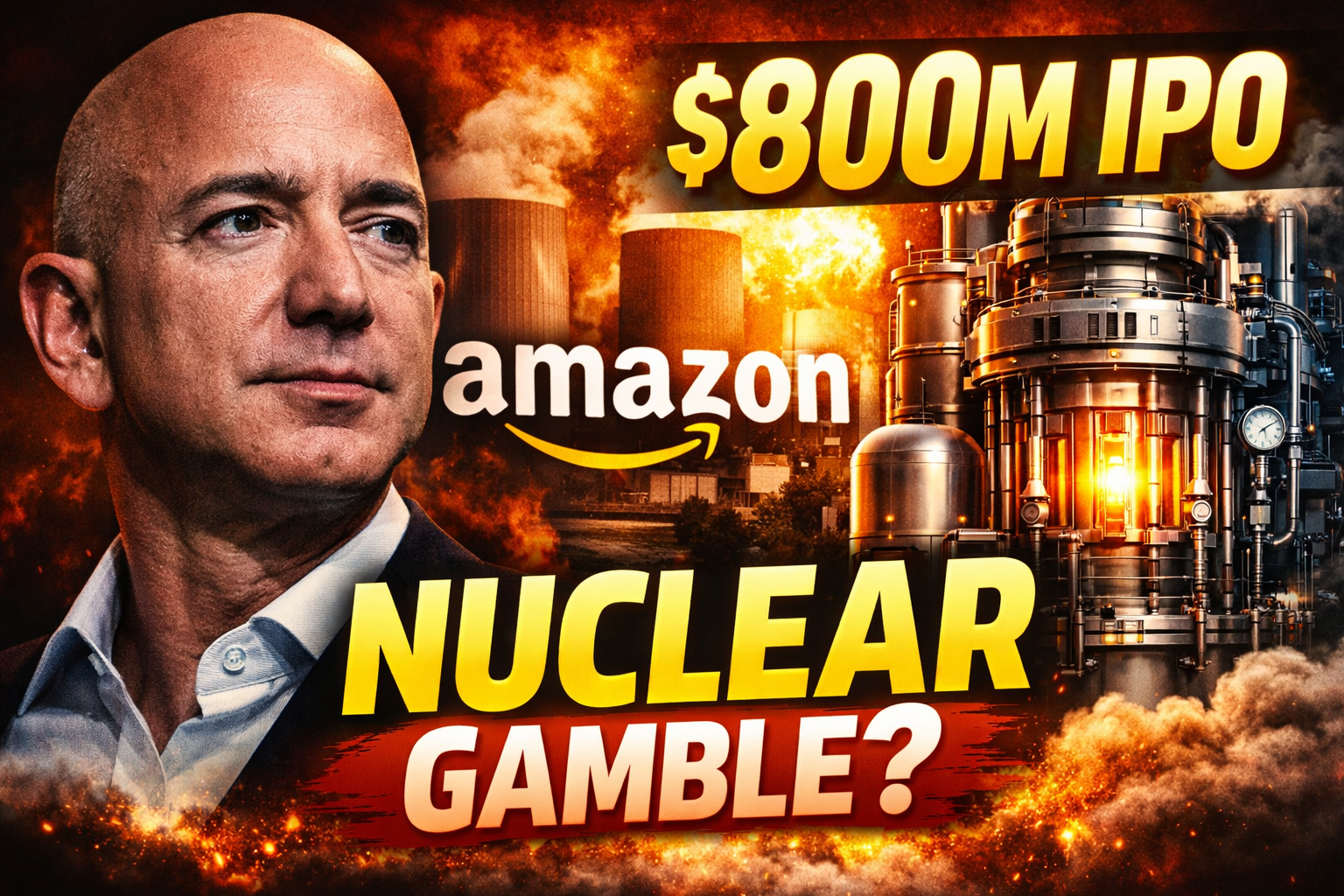
X-energy is raising up to $800M in its IPO, backed by Amazon's $500M investment. Here's why Big Tech is turning to nuclear power, how X-energy's reactor technology works, and the real risks investors face.
- IPO target raise: up to $800 million
- Target share price: $16 to $19 per share
- Total funding raised to date: approximately $1.8 billion
- Amazon investment: $500 million
- Amazon's nuclear power target: 5 gigawatts by 2039
The World's Most Controversial Energy Source Just Got a $800 Million Second Chance
For decades, nuclear energy was the technology that the future kept promising and the present kept rejecting. Three Mile Island. Chernobyl. Fukushima. Each incident added another layer of public anxiety, regulatory friction, and financial caution to an industry that was theoretically the answer to clean, reliable, large-scale electricity generation.
Then the artificial intelligence revolution happened. And suddenly, the energy math changed entirely.
AI data centers consume electricity at a scale that makes conventional power planning inadequate. Every major technology company is facing the same fundamental problem: they need enormous amounts of clean, reliable electricity, they need it continuously, and the existing grid cannot reliably provide it at the required scale. Solar and wind are abundant but intermittent. Natural gas is reliable but carbon-intensive. And nuclear — once dismissed — is looking increasingly like the only technology that can provide what AI infrastructure actually requires.
Enter X-energy. And a planned IPO that could raise up to $800 million from investors willing to bet that nuclear energy's comeback is real — and that X-energy will be one of its primary beneficiaries.
Amazon's Nuclear Bet — Why the World's Biggest Cloud Company Is Buying Reactors
The most important signal in X-energy's story is not the IPO. It is the investor behind the IPO.
Amazon led a $500 million funding round in X-energy — an investment that would have seemed eccentric a few years ago for a company whose primary business is selling books, cloud computing, and same-day delivery. But Amazon is not investing in nuclear energy out of idealism. It is investing out of necessity.
Amazon Web Services — AWS — is the infrastructure backbone of a substantial portion of the internet. As AI workloads have expanded dramatically, AWS's electricity consumption has grown with them. Training large AI models requires computing infrastructure that runs continuously at high intensity. Running AI inference at commercial scale — answering millions of queries per day across AWS's AI services — adds further demand. And Amazon has made public commitments to power its operations with renewable energy that are now coming into tension with its rapidly growing electricity needs.
The company has committed to purchasing up to 5 gigawatts of nuclear power by 2039. That is not a symbolic gesture. Five gigawatts is the equivalent of approximately five large conventional nuclear power plants. It is a procurement commitment that requires nuclear energy to actually be built and operational at scale, which is why Amazon's investment in X-energy is strategically motivated rather than financially speculative.
Amazon is not the only technology company making this calculation. Microsoft has signed agreements with companies developing nuclear power. Google has announced nuclear procurement commitments. Meta has expressed interest. The convergence of AI electricity demand and clean energy commitments is driving a wave of corporate interest in nuclear that the industry has not experienced in decades.
What X-Energy Actually Builds — And Why It Is Different
X-energy is not trying to build the kind of nuclear reactor that generates the controversy and construction delays that have defined the industry for decades. It is pursuing a fundamentally different approach — and understanding the difference matters for evaluating both the opportunity and the risk.
Traditional large nuclear power plants are enormous, complex, highly customized structures that take ten to twenty years and billions of dollars to design, approve, and build. They are essentially one-of-a-kind projects, which means every construction challenge is encountered for the first time and every cost overrun is unique to that particular plant.
X-energy is building what the industry calls a small modular reactor — specifically, a high-temperature gas-cooled reactor. The "small" part means the reactor produces much less power than a conventional plant, but is designed to be factory-manufactured in standardized units and assembled on-site like components rather than built from scratch. The "modular" part means multiple units can be combined to create larger power outputs, scaled to match demand.
The fuel X-energy uses is called TRISO — tristructural isotropic — fuel. Think of each fuel particle as a tiny ceramic ball roughly the size of a poppy seed, surrounded by multiple protective layers. If the reactor were to experience a malfunction or lose cooling — the scenario that drives public anxiety about nuclear safety — the fuel particles themselves contain the radioactive material. They cannot melt down in the way that conventional nuclear fuel can, because the physics of their design prevents the kind of temperature cascade that has caused historical accidents.
The analogy that reactor designers use is instructive: conventional nuclear fuel is like a candle that can set the room on fire if something goes wrong. TRISO fuel is like a candle that automatically extinguishes itself. The safety is inherent in the design, not dependent on external cooling systems working correctly under emergency conditions.
Whether this theoretical safety advantage translates into regulatory and public acceptance at the scale X-energy needs is a separate question — and one that remains genuinely open.
The Industry Trend X-Energy Is Riding
X-energy's IPO timing is not accidental. It is positioning itself to capture capital at a moment when the confluence of AI energy demand and clean energy policy has created conditions more favorable to nuclear investment than anything the industry has seen in thirty years.
Electricity demand in the United States, which had been largely flat for more than a decade, is now growing at rates that are straining grid planning assumptions. The combination of AI data centers, electric vehicle adoption, and industrial electrification is creating demand growth that existing generation capacity is not prepared to meet.
Clean energy policy — both in the United States and globally — is creating financial incentives for low-carbon generation that include nuclear. The Inflation Reduction Act in the United States provides tax credits for nuclear energy production that improve the economics of new plants meaningfully. European governments are reconsidering nuclear moratoriums. Several countries that had committed to phasing out nuclear are reversing or modifying those commitments.
Against this backdrop, X-energy is attempting to raise capital for a technology that is genuinely promising but genuinely unproven at commercial scale. The IPO is, in a meaningful sense, asking investors to fund the proof.
The Risks — And They Are Substantial
Every piece of genuinely balanced analysis about X-energy has to spend considerable time on the risks, because they are real, significant, and not adequately captured by the excitement around the investment thesis.
The Patent Dispute
X-energy is currently involved in a patent dispute with Ultra Safe Nuclear Corporation — USNC. Patent litigation in a capital-intensive, highly regulated industry creates uncertainty that affects financing, partnerships, and regulatory relationships. The bankruptcy complications associated with this dispute add further legal complexity. For a company that has not yet built a commercially operational reactor, legal uncertainty of this kind is a meaningful operational risk that prospective investors need to understand.
No Proven Commercial Track Record
There is currently no small modular reactor of any design that is fully operational and commercially generating electricity anywhere in the world at scale. X-energy is asking investors to fund a technology that is theoretically sound, regulatory-approved in preliminary stages, and backed by credible institutional investors — but that has not been proven in commercial operation.
The history of nuclear energy is filled with designs that were theoretically sound and practically problematic. The transition from promising technology to reliable commercial operation is where nuclear projects consistently encounter challenges that were not visible during the development phase.
The First-of-a-Kind Cost Problem
The nuclear industry has a well-documented phenomenon called the FOAK problem — First Of A Kind. The first reactor of any new design costs dramatically more to build than subsequent versions, because every decision is new, every supplier relationship is being established for the first time, and every construction challenge has no precedent to learn from.
X-energy acknowledges this directly, projecting approximately 30% cost reduction as manufacturing scales. But that 30% reduction happens over roughly ten years of production scale-up. In the meantime, the first several reactors will be built at costs that may not be economically competitive with alternative electricity sources. Whether X-energy can finance the gap between current costs and eventual competitive costs is one of the most important questions hanging over the investment case.
Nuclear Industry Delays
The nuclear industry has a genuinely poor track record on construction timelines and cost management. This is not unique to any particular company or design — it is a systemic characteristic of an industry that operates under intense regulatory scrutiny, with complex supply chains, workforce requirements that are different from conventional construction, and public opposition that can create additional procedural delays.
X-energy's business model depends on delivering reactors on schedule and within budget at a scale the industry has never achieved. That is a high bar.
The Financial Reality — What Investors Are Actually Buying
An IPO investment in X-energy is an investment in a vision of how the world's energy future could look — and a bet that this particular company will be one of the companies that makes that vision real.
It is not an investment in a company with proven revenue, a demonstrated product, or a clear path to near-term profitability. The company expects costs to decrease by approximately 30% over time as manufacturing scales, but that time horizon is roughly a decade. In the near term, the business will require continued capital investment to bridge from current cost levels to eventual commercial competitiveness.
The $800 million IPO raise, combined with $1.8 billion already raised, represents substantial capital commitment to a technology that has not yet demonstrated commercial viability. The investors who have committed that capital — Amazon most notably — have strategic reasons to want the technology to succeed that go beyond financial returns. Public market investors do not have those strategic motivations. They are taking a pure financial position on the probability and timeline of commercial success.
For risk-tolerant investors with a long time horizon and genuine belief in the nuclear energy thesis, X-energy is one of the few ways to take a public market position on small modular reactor technology. That is genuinely valuable as an investment opportunity — but only if the risk profile is understood clearly rather than obscured by the excitement of Amazon's involvement or the narrative of nuclear energy's comeback.
What to Watch — The Signals That Will Determine the Outcome
For investors following X-energy after its IPO, a handful of milestones will be more meaningful than quarterly earnings or stock price movements in the near term.
The legal resolution of the USNC patent dispute will clarify a significant source of uncertainty. A favorable or settled outcome removes a risk that is currently embedded in the company's valuation discount. An unfavorable outcome could create material complications for the technology roadmap.
The progress toward the first commercial reactor's criticality — the point at which the reactor sustains a nuclear chain reaction — is a technical milestone that will demonstrate whether the design performs as modeled. This is the moment that separates promising engineering from proven technology.
The actual cost of building the first few reactors, compared to projections, will provide the most important signal about whether the FOAK problem is being managed as well as X-energy's leadership believes it can be. Cost overruns on the first reactor are not necessarily fatal — they are anticipated. But the magnitude of those overruns will inform the timeline to commercial competitiveness significantly.
The Big Picture: AI Changed Nuclear's Future
The most remarkable thing about X-energy's IPO is not the technology or the valuation. It is the context in which it is happening.
Nuclear energy's revival is being driven by artificial intelligence — an industry that did not exist at meaningful commercial scale when the last serious wave of nuclear investment occurred. The appetite of AI infrastructure for clean, continuous, large-scale electricity has created demand conditions that no energy planner anticipated five years ago and that the nuclear industry is scrambling to position itself to meet.
X-energy is a high-risk, high-reward investment in a genuinely important problem with a genuinely promising solution. Whether it is the right company, with the right technology, executing well enough to capture the opportunity that the AI energy crisis has created — that is the question that the next five to ten years will answer.
Final Perspective
The irony of the AI revolution is that the technology reshaping the future may ultimately be powered by an energy source from the past — one that the world rejected for decades and is only now reconsidering because nothing else can provide what the future actually needs. X-energy is betting that this reconsideration is real and permanent. The $800 million question is whether the execution can match the vision.