Sam Altman Attack New york OpenAi Controversy
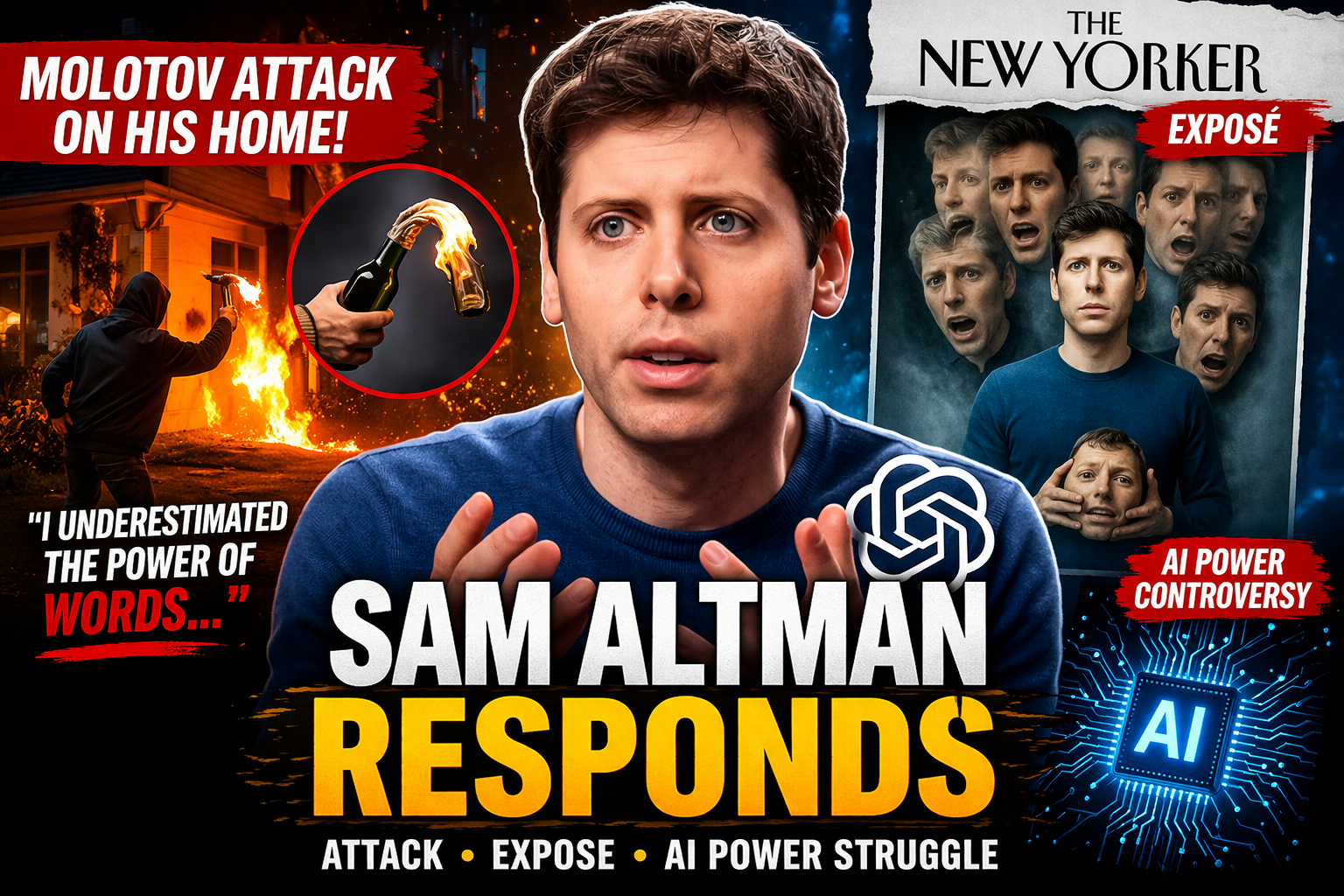
Sam Altman has faced a lot in his career. Board coups. Public criticism. The weight of leading the world's most powerful AI company. But nothing quite prepared him for a Molotov cocktail being thrown at his home. In a rare, deeply personal response, the CEO of OpenAI spoke out — not just about the attack, but about a scathing investigative piece in The New Yorker, his own flaws as a leader, and the future of artificial intelligence. What he said matters far beyond the headlines.
The Attack That Changed the Conversation
An alleged Molotov cocktail was thrown at Sam Altman's San Francisco home. No one was injured. The suspect was arrested. And by most accounts, the incident could have been far worse.
But the real significance of the attack wasn't the fire. It was what it revealed — that narratives about powerful people in the tech world carry real-world consequences. Words on a screen, articles in major publications, posts that go viral — they shape how people feel about someone. And sometimes, those feelings turn into actions.
Altman acknowledged this directly. He admitted he was initially dismissive when people warned him that the coverage around him was becoming dangerous. He didn't take it seriously enough. Then the attack happened, and suddenly the "power of words" became very real to him.
The New Yorker Investigation: 100+ Sources, One Damning Portrait
Written by Ronan Farrow and Andrew Marantz, the New Yorker profile of Sam Altman was not a casual piece. It was built on interviews with more than 100 sources — former colleagues, employees, industry insiders, and people who have worked closely with Altman over the years.
The picture it painted was unflattering.
The article described Altman as someone with a "relentless will to power" — a person who is charming and visionary on the surface, but who operates with a calculated intensity that makes people around him uneasy. It raised questions about his trustworthiness, his management style, and whether someone with his level of ambition should be in control of technology as powerful as what OpenAI is building.
The piece referenced the dramatic events of November 2023, when OpenAI's board attempted to fire Altman — only for him to return days later after a wave of support from employees and investors. The New Yorker framed that episode not as a vindication of Altman, but as evidence of how effectively he can consolidate power when threatened.
For Altman, reading the article was not easy. He described feeling angry, shaken, and deeply uncomfortable. Not because it was all false — but because some of it hit close to home.
Altman's Response: Flawed, Conflict-Avoidant, But Trying
What made Altman's public response notable was its honesty. He did not come out swinging. He did not dismiss every criticism or accuse the journalists of bias.
Instead, he admitted to being flawed.
He acknowledged that he has a tendency to avoid conflict — a trait that has caused problems in how he communicates with people around him. He admitted that his conflict-avoidant style likely contributed to the confusion and dysfunction that led to the 2023 board crisis. He said he wants to do better, and that he recognises the responsibility that comes with his position.
He also issued an apology — not a vague corporate one, but a direct acknowledgment that he has hurt people, made mistakes in leadership, and that he is working on himself.
Whether you find that convincing depends on your level of trust in Silicon Valley CEOs offering public self-reflection. But the fact that he said it at all — with specificity — is worth noting.
AI as Shakespearean Drama
Perhaps the most revealing moment in Altman's response came when he described the AI industry itself.
He called it "Shakespearean drama."
The stakes are extraordinarily high. The personalities involved are enormous. The competition is fierce and deeply personal. And at the centre of all of it is something Altman called the "ring of power" — control over AGI, or artificial general intelligence.
The ring of power is an apt metaphor. In Tolkien's world, the ring corrupts everyone who possesses it. In the AI world, the question being asked by critics, regulators, and thoughtful observers is: should any single person, company, or board be trusted with that kind of control?
Altman says no — and he says OpenAI agrees.
His stated vision is that AGI should not be controlled by one entity. It should be developed carefully and shared broadly — for the benefit of all of humanity, not just shareholders, investors, or the people who happen to work in San Francisco tech companies.
Whether OpenAI's current structure actually supports that vision is a legitimate debate. The company has shifted toward a more commercial model in recent years, and its partnership with Microsoft raises real questions about independence. But Altman's articulation of the goal is clear: no single point of control over the most powerful technology in human history.
Why This Moment Matters Beyond Sam Altman
This story is bigger than one CEO, one article, and one attack on one home.
It raises questions that apply to the entire AI industry — and frankly, to anyone building technology at scale in the current environment.
How do we hold powerful people accountable without creating conditions where criticism turns into danger? How do media organisations cover AI leaders in ways that are rigorous without being reckless? And how do those leaders respond to scrutiny in ways that are honest rather than defensive?
Altman's call at the end of his response was simple: reduce the extremity of the rhetoric. Encourage constructive debate. Recognise that the way we talk about AI — and the people building it — shapes public understanding, policy decisions, and in extreme cases, real-world safety.
That is not a call to silence criticism. The New Yorker piece, based on extensive reporting, is exactly the kind of accountability journalism that powerful people should face. But there is a difference between rigorous investigation and the kind of dehumanising, all-or-nothing framing that turns complex human beings into villains deserving of violence.
The Bigger Picture: AI, Power, and Public Trust
Sam Altman is one of the most consequential figures in technology today. OpenAI's products are used by hundreds of millions of people. Its models underpin products across industries. Its decisions about safety, access, and governance shape what artificial intelligence looks like for the rest of the world.
That kind of power demands scrutiny. It demands transparency. It demands leaders who can take criticism seriously, acknowledge mistakes genuinely, and hold themselves accountable to something larger than their own ambition.
Whether Altman is that kind of leader is something only time — and continued reporting — will answer.
But the conversation he has opened up, about power, words, consequences, and the responsibility of building transformative technology, is one that the entire industry needs to have. Not just in the pages of The New Yorker, and not just when a Molotov cocktail forces the issue into the open.
Key Takeaway
The real story is not the attack, or even the article. It is the question at the centre of the AI age: who do we trust with the most powerful technology ever built — and how do we hold them accountable when something goes wrong?