Two College Students Just Raised $5M to Build a Social Network — And It Does Not Even Have an App
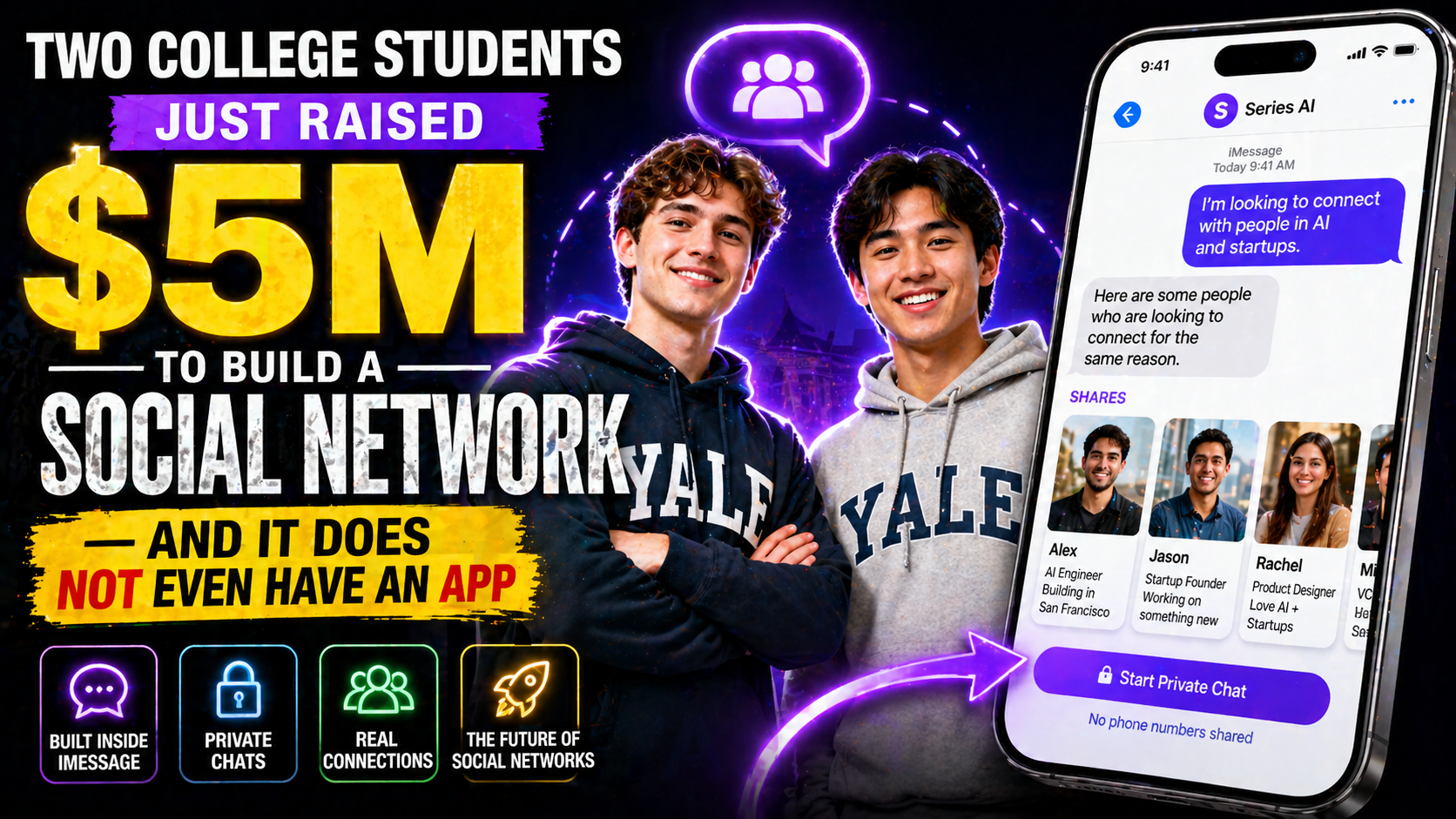
Series is an AI-powered social network that lives entirely inside iMessage. Built by two Yale students, it has raised $5.1M, is live on 750+ campuses, and has 82% Day-30 retention. Here's why it matters.
- Raised: $5.1 million pre-seed
- Active on: 750+ campuses
- Day-30 retention: 82% — comparable to early Facebook
- Team size: ~8 people
- Platform: Runs entirely inside iMessage — no app download required
Two College Students Just Raised $5M to Build a Social Network — And It Does Not Even Have an App
The history of social networking is a history of platforms that required you to go somewhere new. MySpace required a profile page. Facebook required an account and a login. Instagram required a download. TikTok required another download, another algorithm to learn, another feed to scroll through.
Every generation of social platform has added a new destination — a new place you had to go, a new interface you had to learn, a new context-switching cost imposed on your attention.
Series is built on the premise that the next generation of social networking will not add a destination. It will live inside a place you already are.
That place is iMessage. And two Yale students — who have not dropped out — just raised $5.1 million to prove that a social network does not need an app to be the most engaging one you have ever used.
What Series Actually Is
Series is an AI-powered social networking platform that operates entirely within iMessage. There is no standalone application to download. There is no new account to create with a username and password. There is no feed to scroll, no profile to curate, no algorithm to game.
Instead, you text the Series AI. You describe what you are looking for — a professional connection in a specific field, a potential collaborator for a project, someone with shared interests, or any other kind of human connection you are trying to make. The AI processes your description, searches across its user base, and returns a carousel of profiles — "shares," in the product's terminology — directly inside your iMessage conversation.
If you see someone you want to connect with, you can do so privately. Critically, you do not share your phone number. The connection happens through the AI intermediary until and unless both parties choose to exchange contact information directly. The privacy architecture is intentional — it lowers the barrier to expressing interest in connecting while maintaining the kind of protection that makes people comfortable using the platform for professional, social, and romantic discovery.
The concept is deceptively simple. But the implications for how social networking works are significant.
The Founders: Still in College, Already Building Infrastructure
Series was built by two students at Yale University — and notably, neither of them dropped out. In an era when startup mythology still celebrates the college-dropout founder as a kind of archetype, Series represents a quieter but perhaps more sustainable model: building something genuinely ambitious while finishing an education, demonstrating through execution rather than dramatic gesture that the idea is worth pursuing.
The AI-first mindset is not an afterthought in how Series was built — it is the foundational design decision. Rather than building a conventional social app and adding AI features, the founders designed around the question of what a social network could look like if AI was the primary interface from day one. The answer they arrived at was: it might not look like an app at all. It might look like a conversation.
The Funding and the Investors Behind It
The $5.1 million pre-seed round has attracted backing from founders, venture capitalists, and tech leaders who see in Series evidence of a direction that consumer social has been heading toward for some time — and that most of the industry has been slow to act on.
For a pre-product company founded by college students, the credibility of the investor base matters as a signal. It suggests that the people who have built and funded social platforms before see something in Series's approach that resonates with their experience — that the friction of new apps is a genuine problem, that AI-mediated connection has real potential, and that the specific implementation Series has built is compelling enough to justify early capital.
The pre-seed stage is early. Many things can go wrong between a promising prototype and a sustainable business at scale. But the combination of the funding amount, the investor quality, and the early traction numbers suggests this is not just an interesting idea — it is a product that people are genuinely using and returning to.
The Big Shift: AI as the Interface
To understand why Series is interesting beyond its specific product, you need to understand the paradigm shift it represents — and why that shift has been anticipated for years but rarely implemented well.
The history of human-computer interaction has been a series of transitions in how people access information and each other. Web search changed the paradigm from navigating to known destinations to querying for unknown ones. Social networks changed it from finding people you knew to discovering people you did not. Smartphones changed the form factor from desk-bound to always-present.
Each of these transitions felt obvious in retrospect and non-obvious in advance. The move from Google Search to conversational AI interfaces — from typing keywords to asking questions and getting direct answers — is an analogous transition that is currently underway. ChatGPT's growth demonstrated that a significant portion of the population will adopt a conversation-based interface for information access when the experience is genuinely better than the alternative.
Series is applying the same logic to social connection. Instead of navigating to a profile page, instead of scrolling through an algorithmic feed, instead of swiping through a deck of photos — you describe what you are looking for in natural language, and an AI finds it for you. The interface is conversation. The experience is intent-driven rather than serendipity-driven.
This is not just a different UI. It is a fundamentally different mental model for how social connection works.
What Series Is For: More Than One Use Case
Series is positioned as a general-purpose connection platform rather than a single-use-case product, which is both its strength and one of its early challenges. The platform supports several meaningfully different connection types:
Professional networking — finding collaborators, potential employers, advisors, or peers in specific fields. The comparison to LinkedIn is obvious, but the interaction model is radically simpler. Instead of maintaining a profile and hoping the right person happens to see it, you describe exactly what kind of professional connection you are looking for and let the AI search for it.
Business development and partnerships — connecting with potential co-founders, clients, or business partners. The startup and founder community has been an early adopter segment, likely because the need for these connections is high and the existing tools for making them are consistently frustrating.
Dating and romantic connection — a segment where the existing market is large and deeply dissatisfied with current options. The privacy architecture of Series — no phone number sharing until both parties choose to exchange — addresses one of the primary concerns users have with dating apps.
Friendship and social discovery — finding people with specific shared interests in your area or online community. This is perhaps the most underserved category in current social platforms, where algorithmic content distribution has increasingly replaced direct person-to-person discovery.
The Numbers That Matter: Traction as Proof of Concept
Early-stage startup traction numbers should always be interpreted with caution — small absolute numbers can be made to look impressive with selective framing, and most metrics look good during an initial novelty phase. With that caveat stated, Series's reported traction numbers are genuinely notable.
The product is active across more than 750 campuses. For a company of eight people with a pre-seed funding level, reaching that kind of geographic distribution suggests either an unusually effective viral growth mechanism or an unusually strong product-market fit — or both. Campus network effects are real: once a platform reaches meaningful penetration in a specific campus community, the value of being on it for other members of that community increases.
The Day-30 retention rate of 82% is the number that stands out most significantly. In consumer social, retention at this level at 30 days is genuinely exceptional — comparable to the benchmarks that early Facebook achieved during its campus rollout period. Most apps see steep drop-off curves where 30-day retention is a fraction of initial download or sign-up numbers. An 82% figure suggests that the people who try Series are finding enough value in it to keep using it a month later, which is a strong signal that the product is solving a real problem rather than just generating initial curiosity.
Growth Strategy: Distribution Through Story
Series's early growth benefited significantly from a viral LinkedIn launch video that generated rapid investor attention and broad awareness within the startup community. This is worth noting as a model for how early-stage startups can achieve distribution without marketing budgets — through compelling storytelling that resonates with a community's existing interests and assumptions.
The story Series tells — two Yale students, no app, AI as the interface, strong early traction — is inherently compelling to the startup and tech communities that dominate LinkedIn. Each element of the story reinforces a different aspect of why the company is interesting. The college founder angle resonates with the startup mythology of building something important during formative years. The no-app framing is immediately counter-intuitive and demands explanation. The AI-first positioning connects to the dominant technology conversation of the moment.
Whether this narrative continues to drive growth as the company moves beyond the initial founder community into mainstream user adoption is one of the central questions for Series's next phase.
The Competitive Landscape
Series is not the only company experimenting with AI-mediated social connection. The broader category of conversational or AI-first social networking has attracted multiple startups, and established platforms have been adding AI features to their existing products.
But Series has a specific positioning advantage: it is not asking users to adopt a new platform. By building inside iMessage — a platform that already has near-universal penetration among the Gen Z and young professional demographic it is targeting — Series removes the adoption barrier that kills most social apps before they reach critical mass. You do not need to convince users that iMessage is worth using. It already is. You only need to convince them that texting Series AI is worth trying once.
This distribution advantage is significant and partially explains the campus traction numbers. Getting someone to text a number is a much lower friction action than getting them to download an app, create an account, fill out a profile, and start using a new interface. Series's adoption curve starts from a meaningfully lower barrier than any standalone app competitor.
Team and Execution: Eight People, Multiple Pivots
Building a social product that works requires rapid iteration based on user feedback — and the willingness to change direction when the data suggests the current approach is not working. Series's team of approximately eight people has reportedly worked through multiple product pivots to arrive at the current version.
This iteration history is often a positive signal rather than a negative one. Products that find strong traction on the first attempt are the exception, not the rule. The willingness to discard approaches that are not working and the ability to identify what is working in their place — while maintaining the team cohesion and investor confidence required to keep building — are evidence of execution capability that matters as much as the initial idea.
Balancing startup execution with ongoing university enrollment is also an underappreciated signal. It suggests founders who are capable of operating in ambiguous, high-pressure environments without the drama of a public dropout narrative — a maturity of approach that investors focused on long-term execution often find reassuring.
Social Networks Are Shifting From Content to Connection
The deeper insight behind Series's product model is a diagnosis of what has gone wrong with social networking at scale.
The dominant social platforms of the past decade — Instagram, TikTok, Twitter/X, YouTube — are fundamentally content platforms. They are organized around the creation and consumption of content, and they use algorithmic recommendation to surface content to users based on engagement prediction. Connection between specific people is secondary to content discovery; relationships are a byproduct of shared content consumption rather than a primary product feature.
This content-first model has produced platforms with extraordinary scale and engagement — and a widespread feeling among users that social networks are increasingly passive, alienating, and disconnected from the actual relationships people want to build. The serendipitous discovery of an interesting person through shared content is increasingly rare on platforms optimized for maximum engagement rather than meaningful connection.
Series inverts this model entirely. There is no content feed. There is no algorithm surfacing posts for you to consume. There is only the expression of what kind of connection you are looking for, and an AI trying to find it. The platform is connection-first in a way that current social networks are not — and the retention numbers suggest that this approach resonates with users who are looking for something that the existing platforms have stopped providing.
Future Outlook: Where Social Goes From Here
Series represents one possible direction for how social networking evolves over the next decade — toward AI-mediated, intent-driven connection experiences that live inside existing communication platforms rather than requiring standalone apps.
If this direction proves correct, the implications for the current generation of social platforms are significant. A meaningful portion of the social connection use case that currently drives usage of LinkedIn, dating apps, and even parts of Instagram could migrate to AI-first platforms that are more effective at matching people based on stated intent rather than algorithmic inference.
The size and speed of any such migration will depend on how quickly AI-mediated matching actually proves better than algorithm-mediated discovery in practice — and on whether platforms like Series can scale their matching quality as their user bases grow beyond the initial early adopter communities where strong retention is relatively easy to achieve.
These are open questions. But the combination of a compelling product concept, strong early metrics, and a distribution advantage that most competitors lack makes Series one of the more interesting social startups to watch in the current cycle.
Final Takeaway
The next generation of social networks will not look like apps. They will feel like conversations — interfaces that understand what you are looking for and find it for you, rather than environments you navigate through hoping to stumble across it. Series is an early and credible attempt to build toward that future. Whether it becomes the platform that defines this transition or a stepping stone that demonstrates its viability for others to follow is a question that only time and execution will answer. But the direction it is pointing is almost certainly the right one.