OpenAI Is No Longer Exclusive to Microsoft — And Amazon Wasted No Time Moving In
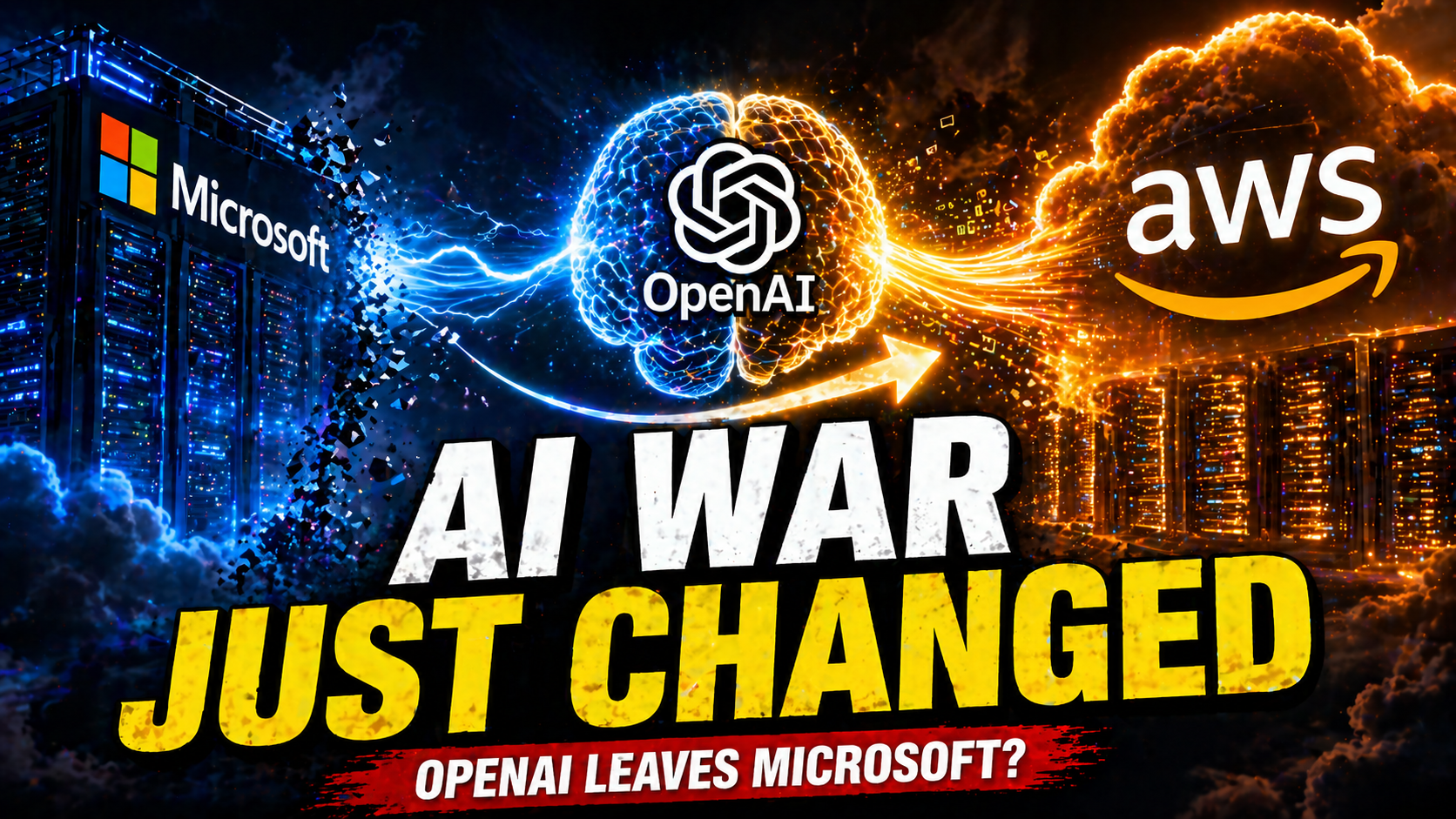
Amazon now offers OpenAI models on AWS Bedrock — ending Microsoft's exclusive hold. Here's what this means for the AI cloud war, enterprise developers, and the future of AI partnerships.
- Amazon now offers OpenAI models on AWS Bedrock — including Codex and agent tools
- Microsoft has lost its exclusive access to OpenAI's models
- OpenAI is now building partnerships with AWS and Oracle
- Microsoft is responding by deepening its bet on Anthropic and Claude
- The AI cloud war has entered a new, more complex phase
OpenAI Is No Longer Exclusive to Microsoft — And Amazon Wasted No Time Moving In
For years, the relationship between Microsoft and OpenAI was one of the defining partnerships in the technology industry. Microsoft invested billions, integrated OpenAI's models across its entire product suite, and in return received exclusive cloud access that competitors could not touch. It was a deal that gave Microsoft a meaningful head start in the AI race and left Amazon, Google, and everyone else competing with one hand tied behind their back.
That exclusivity is gone. And the moment it ended, Amazon moved.
AWS has integrated OpenAI's latest models — including Codex, its code generation system, and its AI agent tools — directly into Amazon Bedrock. Developers who build on AWS can now access OpenAI's technology without leaving Amazon's ecosystem. The cloud war has just entered a new and significantly more complicated phase.
What Amazon Has Actually Done
The integration is not a minor partnership announcement. Amazon has made OpenAI models available on Bedrock — its central platform for building AI-powered applications — giving enterprise developers direct access to OpenAI's technology within the infrastructure they already use and trust.
The models available include OpenAI's latest generation language models, Codex for code generation, and the tooling required to build AI agents that can plan and execute multi-step tasks. These are not limited preview features — they represent a full-spectrum addition to what Bedrock offers.
Alongside this, Amazon has introduced Bedrock Managed Agents — a new product layer designed specifically for enterprise AI deployments using reasoning models. It provides agent control and steering, security and compliance features appropriate for regulated industries, and infrastructure specifically optimized for the kind of complex, multi-step reasoning that modern AI agents require.
The message to enterprise customers is clear: you can now build serious AI applications, using any of the leading models, on Amazon's infrastructure. You do not need to go to Microsoft for OpenAI. You do not need to maintain separate relationships with different cloud providers for different models. Bedrock wants to be the place where all of it happens.
What Changed: The End of Microsoft's Exclusivity
Understanding why this moment is significant requires understanding what changed at the OpenAI level, not just the Amazon level.
OpenAI's relationship with Microsoft was built around an exclusivity arrangement — Microsoft received priority and exclusive cloud access in exchange for its investment and infrastructure support. That arrangement served OpenAI well during its period of rapid scaling: it provided guaranteed compute, distribution through Microsoft's enterprise relationships, and the financial backing required to develop and run frontier models.
But exclusivity has a cost for OpenAI as well. Being bound to a single cloud provider means limited negotiating leverage, constrained partnership possibilities, and dependency on a single company's strategic priorities. As OpenAI has grown into one of the most valuable private companies in the world, that dependency has become increasingly uncomfortable.
The end of exclusivity reflects OpenAI's maturation as a company. It no longer needs to trade access for investment in the way it once did. It can pursue partnerships with multiple cloud providers simultaneously, maximizing distribution and reducing dependency on any single relationship. That is exactly what it has done — with AWS and Oracle both now part of OpenAI's cloud partner network.
What Is AWS Bedrock — And Why It Matters
To appreciate what Amazon is building, it helps to understand what Bedrock actually is and what Amazon is trying to do with it.
Bedrock is Amazon's managed AI platform — a service that lets developers build AI-powered applications without needing to manage the underlying infrastructure or maintain direct relationships with individual model providers. A developer using Bedrock can choose between models from Anthropic, Meta, Mistral, Amazon's own Titan models, and now OpenAI, through a single unified interface with consistent security, compliance, and billing.
The vision is deliberately ambitious. Amazon wants Bedrock to be for AI models what AWS itself became for computing infrastructure — the default place where serious enterprise applications get built, because it offers the best combination of capability, reliability, security, and ecosystem breadth.
Adding OpenAI to Bedrock is a significant step toward that vision. OpenAI remains the most recognizable name in AI for many enterprise buyers. Having it available on Bedrock removes a key reason a customer might need to go elsewhere, and it signals that Amazon is serious about Bedrock being genuinely comprehensive rather than an Amazon-first alternative.
Amazon's Broader Strategy
The OpenAI integration is one piece of a larger strategic picture that Amazon has been assembling deliberately over the past two years.
Amazon has invested heavily in Anthropic — making it one of the largest investors in the company alongside Google. Anthropic's Claude models have a strong presence on Bedrock. Amazon has also developed its own Nova family of models, providing a proprietary option for customers who prefer Amazon's own technology.
The strategy is not to pick a single AI horse and bet everything on it. It is to build a platform that carries every significant horse and captures the infrastructure value regardless of which one wins the model race. This is a classic platform strategy — Amazon captures value not by being the best model provider but by being the infrastructure layer through which all model providers reach enterprise customers.
For Amazon, this is familiar territory. It is essentially the same strategy that made AWS the dominant cloud provider — not by having the best products in every category, but by being the most comprehensive, reliable, and ecosystem-rich platform that developers and enterprises naturally gravitated toward.
Microsoft's Response: Doubling Down on Anthropic
Microsoft's response to the end of OpenAI exclusivity is instructive about how the competitive dynamics are shifting.
Rather than scrambling to add other model providers to Azure in the way Amazon has done, Microsoft is deepening its investment in Anthropic and building AI capabilities powered by Claude more prominently into its product suite. This reflects a different strategic bet — that owning a deep, exclusive-feeling relationship with a frontier model provider is more valuable than offering a marketplace of options.
Microsoft's position has some genuine advantages. Its existing enterprise relationships, built over decades through Office and Windows, give it distribution that Amazon cannot easily replicate. Its integration of AI capabilities directly into Word, Excel, Outlook, and Teams means its AI story is about making tools people already use more powerful — not about getting enterprises to adopt new infrastructure.
But the end of OpenAI exclusivity does weaken Microsoft's AI narrative. The story of "we have OpenAI and competitors don't" is no longer available. Microsoft now needs to compete on the quality of its integration and the strength of its enterprise relationships rather than on exclusive model access.
The Big Insight: AI Alliances Are No Longer Fixed
The most important thing to understand about the Amazon-OpenAI development is not the specific partnership. It is what the partnership reveals about how AI alliances are evolving.
The AI industry spent 2022 and 2023 organizing itself into relatively stable camps. Microsoft and OpenAI together. Google with DeepMind. Amazon with Anthropic. Meta with open source. These arrangements felt like they were settling into durable competitive positions.
They were not. They were temporary configurations, shaped by the investment needs and strategic constraints of a rapidly evolving industry. As those constraints change — as models become more valuable, as enterprise demand grows, as infrastructure becomes the competitive battleground — the alliances shift accordingly.
OpenAI partnering with AWS while maintaining its relationship with Microsoft. Microsoft deepening its Anthropic investment while still featuring OpenAI in its products. Amazon offering both Anthropic and OpenAI on Bedrock while investing heavily in Anthropic. Google offering both its own models and OpenAI competitors while maintaining its own investments. The lines are no longer clean, and they are not going to become clean again.
The Multi-Cloud AI Future
For enterprise customers, the immediate effect of these shifting alliances is genuinely positive: more choice, better pricing leverage, and reduced dependency on any single vendor's AI roadmap.
The direction is clearly toward a multi-cloud AI world, where enterprises maintain relationships with multiple AI providers and can switch or add providers as capabilities, pricing, and strategic considerations evolve. This is the model that has worked in cloud computing generally — most large enterprises use multiple cloud providers — and it is now extending to the AI layer.
For developers, the practical effect is a maturing ecosystem with more options and more standardization. Frameworks that abstract over multiple model providers are becoming more capable and more widely used. The days of needing to deeply specialize in a single model provider's APIs and quirks are giving way to a world where the infrastructure layer handles provider-specific complexity and developers can focus on building applications.
The Real Competition: Infrastructure, Not Models
Here is the conclusion that the Amazon-OpenAI development points toward most clearly: the competition in AI is no longer primarily about which company has the best model. It is about which company builds the most compelling infrastructure platform for deploying and using those models.
Models will continue to improve rapidly across multiple providers. The quality gap between leading models is real but narrowing. For many enterprise applications, the difference between the leading models is less important than the reliability, security, compliance, and integration quality of the infrastructure they run on.
This is the battle Amazon is positioning itself to win. Not by having the best model — Amazon's own models are capable but not the industry leaders — but by having the most comprehensive, reliable, and ecosystem-rich platform for running whichever models are best for a given use case.
Final Takeaway
The AI race is no longer about which company has the most powerful model. It is about who builds the strongest ecosystem — the platform where the most enterprise applications get built, the infrastructure that developers trust by default, the layer where AI investment flows because it is the most reliable path to production. Amazon has been building that platform for two decades in cloud computing. It is now making its most serious play to do the same thing in AI.