He Built a Startup to Help Students — Then Sued the Company That Bought It to Protect Them
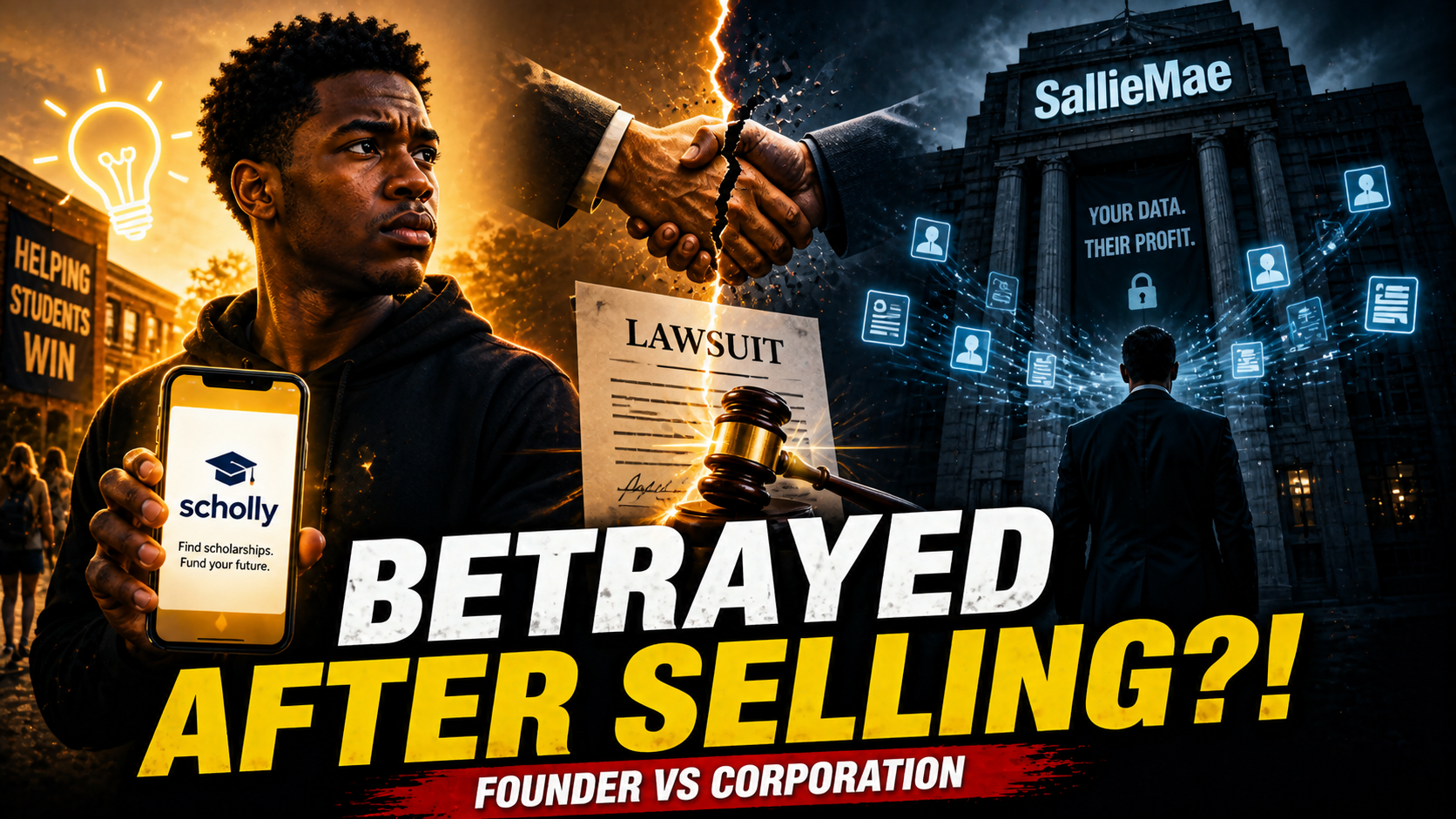
Chris Gray built Scholly to help low-income students find scholarships. After selling it to Sallie Mae in 2023, he alleges user data was sold without consent. Here's the full story — and what it means for startup founders everywhere.
- Scholly founder Chris Gray has sued Sallie Mae for wrongful termination
- Gray alleges Sallie Mae sold user data including age, race, gender and financial information
- A whistleblower complaint has been filed with the SEC
- Sallie Mae denies all allegations and calls the claims without merit
- The case raises serious questions about founder control after acquisition
He Built a Startup to Help Students — Then Sued the Company That Bought It to Protect Them
Every founder who sells their company goes through a version of the same reckoning. The product you built, the users you served, the mission that got you out of bed every morning — all of it now belongs to someone else. The best acquisitions preserve what made the original product valuable. The worst ones extract what they can from the user base the founder spent years building trust with.
Chris Gray built Scholly to solve a problem he had lived personally. Now he is in court alleging that the company that bought it used the trust of millions of students — many of them low-income, many of them from marginalized communities — as a commercial asset to be monetized rather than a responsibility to be honored.
The story raises questions that every founder considering an exit should sit with carefully.
Who Is Chris Gray
Chris Gray did not grow up with financial advantages. He grew up in a low-income household, and getting to college meant figuring out how to pay for it without family wealth to draw on. He did what many students in his situation attempt but few succeed at as comprehensively: he applied for scholarships. Aggressively, systematically, and successfully.
Gray won approximately $1.3 million in scholarships — an amount that not only covered his education but gave him something equally valuable: a deep personal understanding of how fragmented, confusing, and inefficient the scholarship discovery process was for students who needed it most.
That understanding became the foundation of Scholly.
The Startup: What Scholly Was Built to Do
Scholly was a scholarship search and matching platform. The problem it solved was real and significant: tens of billions of dollars in scholarship funding goes unclaimed every year in the United States, not because students do not need it but because they cannot find it. The scholarship landscape is fragmented across thousands of organizations, with varying eligibility criteria, deadlines, and application requirements that are difficult to navigate without dedicated research time most students do not have.
Scholly built a matching system. Students entered their information — academic record, field of study, background, interests, and other eligibility factors — and the platform returned a personalized list of scholarships they were likely to qualify for. It compressed hours of research into minutes and made the process accessible to students who lacked the guidance counselors, networks, or parental experience to navigate it independently.
The mission was personal for Gray. He had been that student. He built a tool for students like him.
Growth and the Path to Exit
Scholly's growth story has the kind of inflection point that startup founders dream about. The company appeared on Shark Tank, where the pitch generated one of the more memorable moments in the show's history — and the resulting publicity drove a surge in downloads that validated the product's appeal at scale.
By the time the acquisition happened, Scholly had accumulated more than five million users and over thirty million dollars in revenue. It had built a substantial and engaged user base of students who trusted the platform to help them navigate one of the most consequential financial decisions of their early lives.
In 2023, Sallie Mae — the student loan and financial services company — acquired Scholly. Gray joined as a Vice President. The apparent plan was to scale the platform, potentially make it free, and expand access using Sallie Mae's resources and regulated banking infrastructure. For a product built to help underserved students, acquisition by a major financial institution with national reach seemed like it could be a genuine amplification of the mission rather than its dilution.
That is not what Gray alleges happened.
What Gray Alleges Went Wrong
According to Gray's lawsuit and the whistleblower complaint filed with the SEC, the experience inside Sallie Mae after the acquisition diverged significantly from what he had understood the company's intentions to be.
The founding team was laid off. The strategic direction inside the company shifted. When Gray raised concerns about how the product and its user data were being handled, his objections were not received constructively. Eventually he was terminated — which he characterizes as wrongful termination in retaliation for raising those concerns.
The core allegation is about user data. Gray alleges that Sallie Mae created a subsidiary — separate from the regulated banking entity — and used it to monetize Scholly's user data in ways that users were not adequately informed about and may not have consented to.
The Data Allegation in Detail
The data that Scholly collected from its users is sensitive by any reasonable standard. To use the matching system, students provided information about their age, race, gender, academic background, financial situation, and personal circumstances. This is exactly the kind of detailed demographic and financial profile that has significant commercial value to universities recruiting specific student populations, to advertisers targeting young adults with financial products, and to data brokers who aggregate and resell personal information.
Gray alleges that this data was sold to universities, advertisers, and data brokers — and that this monetization happened through a structure designed to take advantage of the trust users placed in what they believed was a scholarship search tool, not a data collection and sales business.
Central to this allegation is the creation of a platform called Sallie.com — a separate entity from Sallie Mae the regulated bank. Gray's complaint suggests that the similar branding created potential confusion: users interacting with Sallie.com might reasonably believe they were dealing with the regulated banking institution, with the data protections and oversight that implies, when in fact they were dealing with a separate entity operating under different constraints.
Sallie Mae has additionally created an entity called Backpack Media, which Gray's complaint identifies as a vehicle for monetizing the Scholly user audience. The existence of a dedicated media monetization entity suggests, at minimum, that advertising and data-driven revenue were significant parts of the post-acquisition business model.
The Legal Actions
Gray has filed a lawsuit seeking damages for wrongful termination and backpay. He has also submitted a whistleblower complaint to the Securities and Exchange Commission — a more serious escalation that triggers SEC investigation procedures and, if the allegations are substantiated, could result in regulatory action against Sallie Mae.
Sallie Mae has responded to the allegations by denying them and characterizing the claims as without merit. The legal process will ultimately determine what actually happened — but the existence of the lawsuit and the SEC complaint, and the specificity of the allegations, make this more than a simple employment dispute.
The Big Insight: Founders Lose Control, But Not Responsibility
The Scholly story illuminates a tension that sits at the heart of every acquisition: the founder loses control the moment the deal closes, but they do not lose their responsibility to the users who trusted them.
Users who signed up for Scholly did so because of what Gray built and what Scholly represented. They shared sensitive personal information because they trusted that it would be used to help them find scholarships — not to generate advertising revenue or populate data broker databases. That trust was given to Scholly, which meant it was given to Gray. The acquisition transferred the asset. It did not transfer the trust, and it did not eliminate the ethical obligation that came with it.
This is the position Gray appears to have found himself in: inside a company he no longer controlled, watching decisions being made about users who trusted him personally, with limited ability to stop what he believed was happening and a legal obligation not to speak publicly while employed.
The lawsuit and the SEC complaint are, in a sense, the only tools he had left.
The Startup Lesson: Acquisitions Change Everything
The Scholly case is not unique in its structure. It is a particularly clear example of a dynamic that plays out in acquisitions regularly — the acquiring company has incentives and interests that may differ significantly from those of the founding team, and once the deal closes, the founding team has very limited ability to shape how the product evolves.
Acquisitions change culture. The people who built a product with a specific set of values are often not the people who run it after the acquisition. They may be retained for a transition period, but the decisions that matter — about product direction, about user data, about what the business is actually optimized for — are made by people whose primary accountability is to the acquiring company's shareholders, not to the users of the acquired product.
Acquisitions change values. A startup built around a mission can be acquired by a company whose primary mission is financial performance. The product may survive. The mission often does not, at least not in its original form.
Acquisitions change product direction. What gets built after an acquisition is shaped by the acquiring company's strategic priorities, not the founder's vision. Sometimes those align. Often they do not.
The Broader Implications for Edtech and Data Privacy
The Scholly case sits at the intersection of two of the most sensitive categories in data privacy: student data and financial data. Students are often considered a protected population for privacy purposes — minors are especially protected, and even adult students are frequently targeted by predatory financial products in ways that regulators have identified as harmful.
The edtech sector has faced growing scrutiny over data practices. Platforms that collect detailed information about students — their academic performance, their financial situations, their demographic backgrounds — have significant commercial incentive to monetize that data in ways that may not serve students' interests.
When those platforms are also connected to financial services companies with products to sell to those students, the potential for conflicts of interest becomes acute. A scholarship search platform that also feeds user data to student loan providers, advertisers of financial products, or data brokers presents precisely the kind of structural conflict that makes data privacy advocates most concerned about the edtech sector.
Conclusion: The Battlefield Changes, The Responsibility Does Not
Chris Gray built Scholly because he understood from personal experience what it meant to need financial help getting to college and to face a system that was confusing, fragmented, and hard to navigate without support. He built something that made that system more accessible to students who needed it most.
Whether the allegations against Sallie Mae are proven or not will be determined through the legal process. What is already clear is that the case raises questions that matter well beyond this specific situation: about what happens to mission-driven products after acquisition, about the data obligations of platforms that serve vulnerable populations, and about whether founders who sell their companies bear any ongoing responsibility for how those companies treat the users who trusted them.
Final Reflection
Selling a company does not end the founder's responsibility to the people who trusted what they built. It may simply change the battlefield on which that responsibility has to be fought for. For founders building products that serve vulnerable users — students, patients, people in financial difficulty — the question of what happens to those users after an exit is not a post-deal concern. It is a pre-deal one, and it deserves to be treated as seriously as the valuation.