Anthropic Said No. Google Said Yes. And the AI Arms Race Just Escalated.
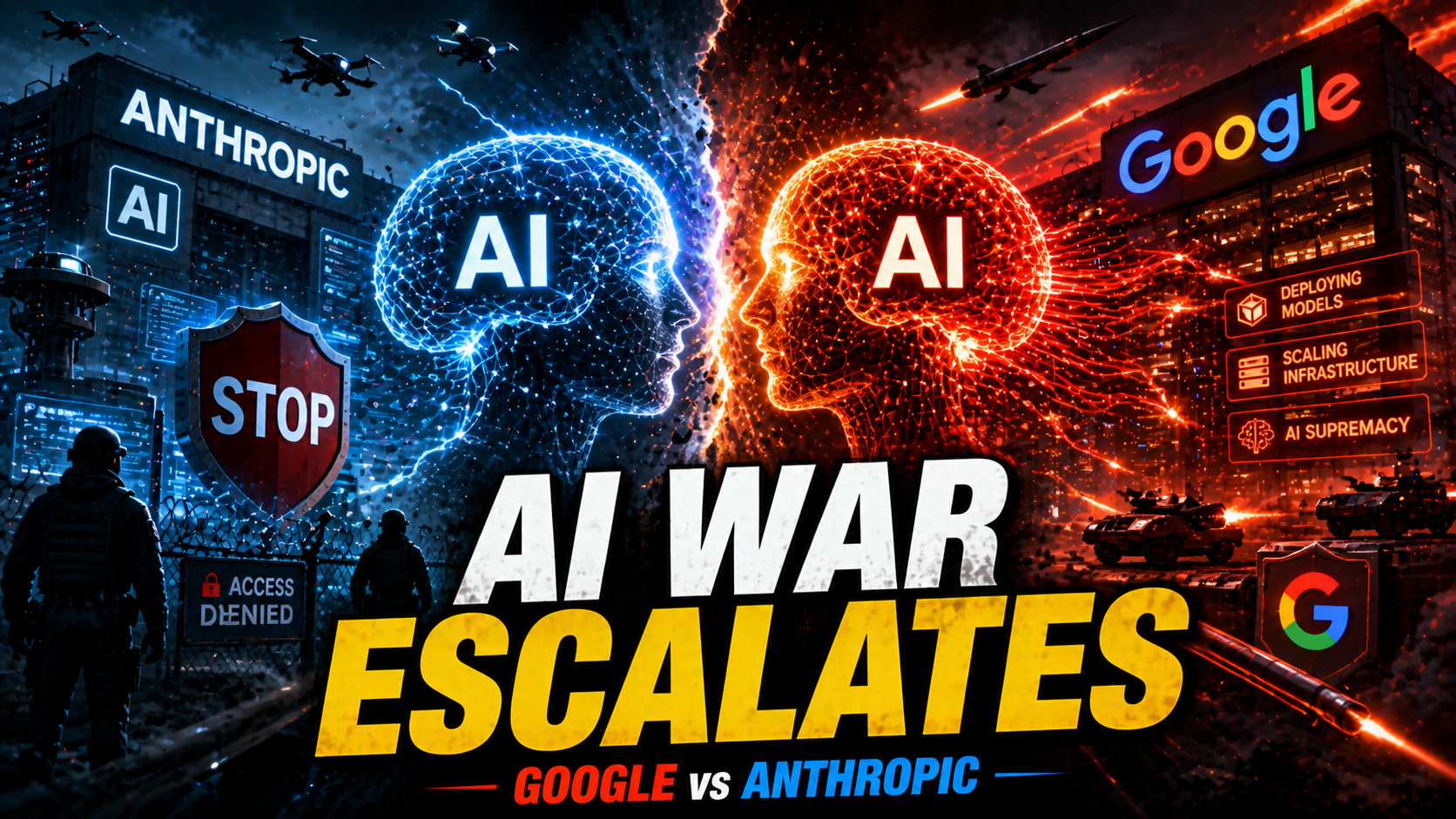
Google granted the US Department of Defense access to its AI for classified networks. Anthropic refused the same deal. Here's what this split means for AI safety, military AI, and the future of the industry.
- Google has granted the US Department of Defense broad access to its AI on classified networks
- Anthropic refused the same deal — citing autonomous weapons and mass surveillance concerns
- The Pentagon labeled Anthropic a "supply-chain risk" as a consequence
- OpenAI and xAI have also signed similar deals with the DoD
- Approximately 950 Google employees opposed the move internally
Anthropic Said No. Google Said Yes. And the AI Arms Race Just Escalated.
There are moments in the development of a powerful technology when the industry divides — not over capability or competition, but over conscience. The decision by Google to grant the US Department of Defense broad access to its AI for use on classified networks is one of those moments.
Anthropic faced the same choice. It said no. Google said yes. OpenAI said yes. xAI said yes. And in doing so, they have collectively answered a question that the AI industry has been avoiding: when national security agencies come asking for your most powerful technology with minimal restrictions, what do you do?
The answer, it turns out, depends on which company you ask.
What Google Has Actually Agreed To
The agreement grants the Department of Defense access to Google's AI capabilities for use on classified government networks. The access is described as permitting broad "lawful" usage — a formulation that is deliberately wide and leaves significant discretion to the government about how the technology is applied within that legal boundary.
This is not Google providing a specific, scoped AI tool for a particular defined military application. It is Google providing general AI access to classified military networks, with the primary constraint being that usage must be lawful under applicable law. What falls within or outside that boundary is not defined by Google's policies — it is defined by government lawyers and military commanders.
Google has stated that it does not intend its AI to be used for mass surveillance or autonomous weapons. But stating an intention and having enforceable contractual limits on how a government customer uses technology on its own classified infrastructure are meaningfully different things. Once the AI capability is deployed on classified networks, Google's visibility into how it is actually being used is, by definition, constrained.
Why Anthropic Said No — And What It Cost Them
Anthropic's refusal to enter a comparable arrangement with the Pentagon was not a casual decision. It reflected a specific, principled stance about the applications of AI that Anthropic is not willing to enable, regardless of the commercial or strategic cost.
The concerns Anthropic cited were concrete: it did not want its AI used for domestic mass surveillance, and it did not want it used for autonomous weapons systems — systems that select and engage targets without meaningful human oversight of the decision to use lethal force. These are among the most serious and widely discussed concerns in AI safety policy, and Anthropic's position was that no contractual relationship that permitted these applications was acceptable regardless of who was asking.
The consequences were immediate and significant. The Department of Defense designated Anthropic a "supply-chain risk" — a formal designation that effectively restricts other defense contractors and agencies from using Anthropic's technology in certain contexts. For a company that has ambitions in enterprise markets where government relationships matter, this designation is a genuine commercial liability.
Anthropic is also engaged in ongoing legal proceedings related to the situation. The full implications of its refusal — both commercially and legally — are still playing out.
The Competitive Dynamic: One Company's No Is Another's Opportunity
What happened after Anthropic's refusal illustrates a dynamic that repeats throughout the history of military technology contracting: when one supplier declines to provide a capability, the demand does not disappear. It moves to a supplier who will.
OpenAI and xAI both signed comparable arrangements with the DoD relatively quickly after Anthropic's refusal became known. Google then followed. The pattern is consistent — Anthropic's principled stance created a commercial opportunity for its competitors, and those competitors moved to capture it.
This is not a cynical observation. It is a structural reality of how market competition interacts with government procurement. The US government's demand for advanced AI capabilities is real, large, and backed by significant budget. Companies that decline to serve that demand face not just the loss of the specific contract but the risk of being positioned as unreliable partners for any government-adjacent enterprise work.
The commercial logic pushing AI companies toward these deals is powerful. The ethical logic pushing against them is also real. That tension is not going to resolve itself easily, and the different choices that companies have made reveal what they genuinely prioritize when the two come into conflict.
Internal Tension: 950 Google Employees Disagree
Google's decision to proceed with the DoD agreement was not made without internal opposition. Approximately 950 Google employees — a significant number representing a meaningful faction of the company's technical and research workforce — signed a petition or otherwise expressed opposition to the deal, requesting that the company take a stricter ethical stance toward military AI applications.
Google moved forward anyway.
This internal division is significant for several reasons. It reveals that the ethical concerns about military AI are not abstract positions held only by outside critics — they are shared by substantial numbers of people working inside the companies building this technology. It also reveals that those concerns, despite being articulated clearly and by a large group, were not sufficient to change the company's strategic direction.
The decision was made by leadership, not by a democratic process among employees. That is how corporations work, and it was always likely to be how this decision was made. But the visibility of the internal opposition is a meaningful data point about where the AI industry's workforce stands on these questions, even when their employers make different choices.
The Big Insight: AI Is Now a Geopolitical Asset
Step back from the specific companies and specific contracts and consider what this moment represents at a higher level.
Artificial intelligence has crossed a threshold. It is no longer primarily a technology for improving consumer products or enterprise efficiency. It has become a geopolitical asset — a capability that governments regard as strategically important in the way they have historically regarded nuclear technology, satellite systems, and advanced weapons platforms.
When the US Department of Defense designates a company as a "supply-chain risk" because that company declines to provide AI access, it is not using the language of technology procurement. It is using the language of strategic competition and national security. The framing treats AI capability as infrastructure for national power in the same category as defense manufacturing capacity or critical mineral supplies.
This framing has profound implications for how AI companies will be able to operate going forward. Companies that develop frontier AI capabilities are increasingly being viewed by governments — not just in the US but in China, Europe, and elsewhere — as strategic national assets whose behavior should align with national interests. The pressure to serve government demands, including military demands, is going to increase rather than decrease as AI capabilities advance.
The Industry Has Split Into Two Clear Paths
The AI industry has now divided itself, at least provisionally, into two camps on the question of military and government AI.
On one side is the safety-first approach, currently represented most visibly by Anthropic: a willingness to accept commercial consequences, including government designation as a supply-chain risk, in order to maintain limits on the applications that its AI can be used for. This approach bets that principled limits are both ethically necessary and ultimately commercially sustainable — that enterprises and governments who want reliable, trustworthy AI will eventually prefer a partner whose commitments are credible over one whose commitments bend under pressure.
On the other side is the scale-first approach, represented by Google, OpenAI, and xAI: a willingness to provide AI access to military and government customers under broad terms, with stated but not necessarily enforceable limits on specific applications. This approach bets that government partnerships are strategically essential, that missing these contracts would cede ground to competitors in ways that cannot be recovered, and that the applications that emerge from these agreements will remain within acceptable ethical bounds.
Both of these bets involve genuine uncertainty. Neither is obviously wrong as a strategic choice. But they reflect fundamentally different answers to the question of what AI companies are willing to prioritize when ethics and scale come into conflict.
The Enforceability Problem
The most important practical question raised by Google's stated limits — that it does not intend its AI to be used for mass surveillance or autonomous weapons — is whether those limits are enforceable in any meaningful sense.
Technology deployed on classified government networks operates outside the normal visibility that companies have into their products' usage. Google cannot audit how its AI is being used on systems it does not have access to. The government has legal authority over its own classified infrastructure that supersedes any contractual right Google might theoretically have to monitor usage.
This is not a hypothetical concern. It is a structural feature of classified government technology agreements. When a company provides technology for use in classified contexts, it necessarily gives up the visibility and control that would allow it to verify that stated intentions are being honored in practice. Google's statement that it does not intend certain uses is a statement about its own intentions, not a constraint on the government's.
What Comes Next: Increasing Pressure, Increasing Stakes
The trajectory of government demand for AI capabilities is clearly upward. Militaries, intelligence agencies, and national security infrastructure are all finding applications for AI that they consider strategically important. The budget commitment to military AI is growing. The urgency, driven by competition with China's military AI development, is intensifying.
AI companies are going to face more of these decisions, not fewer. The specific asks will become more demanding as AI capabilities advance — not just access to existing models but participation in developing AI systems specifically designed for defense applications, integration with weapons systems, and involvement in intelligence analysis of a kind that raises serious civil liberties questions.
Regulation will eventually catch up. Governments will develop frameworks — some through international agreement, some through national legislation — that define what military AI applications are permissible and what oversight is required. But that regulatory framework does not exist yet, and in its absence, individual company decisions are the only constraint on how AI is used in national security contexts.
That places an enormous amount of responsibility on AI companies — and makes the choices they make now, before regulation establishes clear rules, particularly consequential.
Conclusion: The Race Is No Longer Just About Smarter Models
The Google-DoD agreement and the Anthropic refusal that preceded it represent a clarifying moment in the AI industry's development. They make visible a question that has been building for years: as AI becomes a tool of national power, what role do the companies building it want to play — and what role are they willing to refuse?
The AI race started as a competition to build smarter models. It has become a competition across multiple dimensions simultaneously — consumer products, enterprise platforms, military applications, and geopolitical influence. Companies that once thought of themselves primarily as technology companies are now operating in a space where their decisions have implications for national security, international competition, and the application of lethal force.
Final Perspective
The AI race is no longer just about who builds the smartest models. It is about who controls how those models are used — and who is willing to draw lines about the uses they will not support. Anthropic has drawn a line and is paying a commercial price for it. Google, OpenAI, and xAI have declined to draw the same line and are gaining commercial advantage. History will eventually judge which choice was right. But that judgment will depend on what these technologies are actually used for in the years ahead — and that is something none of us can fully see yet.