Meta Is Building a Way to Power AI From Space — Even at Night
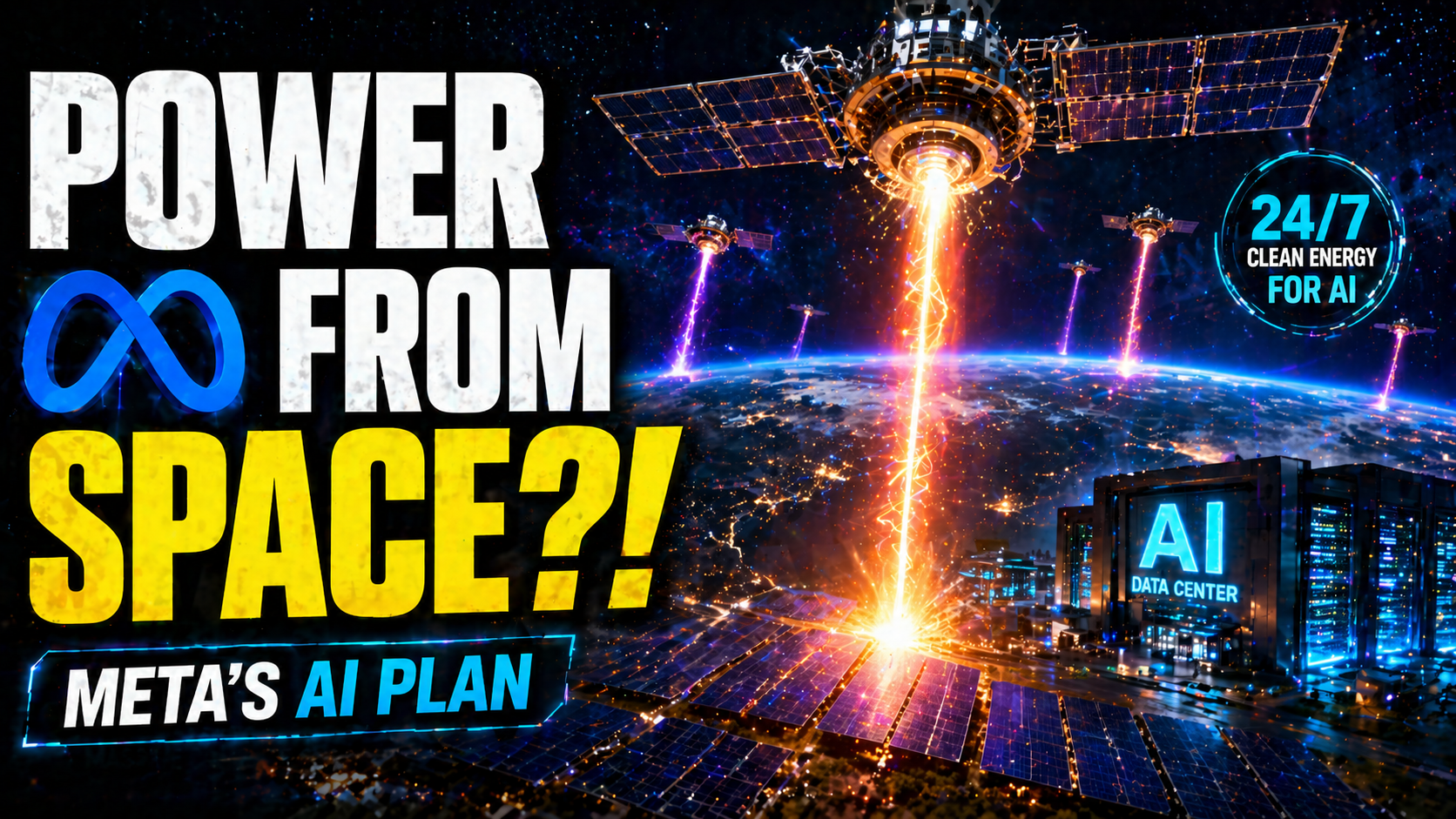
Meta has signed a deal with Overview Energy to receive up to 1 gigawatt of space-based solar power for AI data centers. Here's why this signals a turning point in the AI race — and why energy, not algorithms, is the next big bottleneck.
- Meta's energy target from space: up to 1 gigawatt
- First satellite test: approximately 2028
- Full deployment target: around 2030
- Planned satellite constellation: ~1,000 satellites
- Potential Earth coverage: up to one-third of the planet
Meta Is Building a Way to Power AI From Space — Even at Night
For most of AI's short commercial history, the race has been about intelligence — better models, faster chips, smarter training techniques. The assumption was that the hard part was the algorithm. Get the algorithm right, and the rest would follow.
That assumption is being quietly revised. The hard part, it is becoming clear, is not the algorithm. It is the electricity required to run it.
Meta has just signed an agreement with Overview Energy to receive up to one gigawatt of power — with that energy collected in orbit and beamed down to Earth. It is one of the most ambitious energy deals in the history of technology, and it signals something important about where the AI race is actually heading.
The Deal: What Meta Is Actually Doing
Meta has entered into an agreement with Overview Energy, a company building space-based solar power systems, to receive up to one gigawatt of electricity generated by satellites in orbit. The energy would be used to power Meta's AI data centers — the physical infrastructure that trains and runs its AI models.
One gigawatt is not a trivial amount. It is roughly equivalent to the output of a large nuclear power plant, or the electricity consumption of several hundred thousand homes. For context, a single large AI training run for a frontier model can consume as much energy in weeks as a small town uses in a year. At the scale Meta — and its competitors — are planning to operate, one gigawatt begins to look like a reasonable down payment on future energy needs rather than a ceiling.
The agreement represents a bet on technology that does not yet exist at commercial scale. But it is a calculated bet, made by one of the world's most resource-rich technology companies, on a specific solution to a problem that is already constraining AI development.
The Real Problem: AI Is an Energy Hunger Machine
To understand why this deal matters, you need to understand how much electricity AI actually requires — and how rapidly that requirement is growing.
Training a large language model requires running thousands of high-end GPUs continuously for weeks or months. The electricity consumption during a single major training run can be extraordinary. But training is only part of the equation. Running inference — generating responses for users — requires continuous GPU operation across enormous server farms, 24 hours a day, 365 days a year.
Data centers running AI workloads are among the most energy-intensive facilities ever built. The International Energy Agency has projected that global data center electricity consumption could double by the end of the decade, with AI workloads being the primary driver of that growth. In some regions, utility companies are already struggling to provide the power that planned AI data centers will require.
And then there is the constraint that solar power — currently the fastest-growing and cheapest form of new electricity generation — cannot solve on its own: the sun goes down.
Solar panels produce electricity when sunlight hits them. At night, they produce nothing. This intermittency problem means that solar energy, no matter how cheap it becomes during the day, cannot power data centers that need to run continuously without substantial battery storage or backup generation from other sources. Batteries at the scale required are expensive. Fossil fuels are unsustainable. The math does not currently work cleanly for round-the-clock solar-powered AI.
Space-based solar power is a direct solution to this specific problem.
The Breakthrough: How Space-Based Solar Power Works
The concept of collecting solar energy in space and transmitting it to Earth has been discussed in scientific literature for decades. What has changed recently is the combination of falling launch costs, advances in satellite technology, and the urgent scale of energy demand from AI — which has made a technology that was previously theoretical begin to look practically viable and commercially interesting.
The system Overview Energy is building works in several stages.
First, satellites in orbit collect sunlight. Unlike solar panels on Earth, satellites in high orbit receive sunlight continuously — they are above the atmosphere, above the weather, and above the Earth's rotation cycle that creates day and night. A satellite in the right orbit can collect solar energy 24 hours a day, every day of the year.
Second, the collected energy is converted into infrared light. This conversion step is crucial — it transforms the solar energy into a form that can be transmitted across the distance from orbit to Earth's surface efficiently.
Third, the infrared light is beamed down to solar farms on Earth. These are not conventional solar panels — they are receivers designed to capture the specific infrared wavelengths being transmitted from the satellites. They convert the received infrared light back into electricity.
Finally, that electricity feeds into the grid and from there to the data centers that need it.
Why Infrared — Not Lasers or Microwaves
Earlier proposals for space-based solar power typically involved transmitting energy as microwaves or high-powered lasers. Both approaches carry significant concerns — safety risks from concentrated energy beams, regulatory complexity, and public perception challenges that would make deployment politically difficult.
Overview Energy's infrared approach is designed to avoid these problems. Infrared light at the wavelengths involved spreads significantly as it travels from orbit to the ground, which means it arrives as a diffuse, lower-intensity beam rather than a concentrated point of energy. This dramatically reduces the safety concerns associated with the system and makes the regulatory pathway considerably more straightforward.
The trade-off is that infrared transmission is less efficient than more concentrated alternatives — some energy is lost in transmission. But at the scale being considered, and given the advantages in safety and deployability, the approach appears viable enough to attract investment and commercial agreements from companies like Meta.
The Timeline: When This Actually Happens
This is a long-term bet, not an immediate solution. Understanding the timeline is important for evaluating what this deal represents strategically.
Overview Energy plans the first satellite test for approximately 2028. This would be a demonstration of the core technology — proving that energy can be collected in orbit, converted to infrared, and successfully transmitted to and received by a ground station.
Full commercial deployment is targeted for around 2030, with a constellation of approximately 1,000 satellites. At that scale, the system could potentially provide power coverage to up to one-third of Earth's surface at any given time, with the satellites repositioning continuously to follow demand.
The 2030 target is aggressive. Space infrastructure projects routinely encounter delays. But the direction of travel — and the commercial validation represented by Meta's agreement — suggests that space-based solar is moving from theoretical concept to funded development program.
The Continuous Energy Advantage
The most significant operational advantage of space-based solar over ground-based solar is not the absence of weather interference or atmospheric absorption — it is the continuous availability.
A constellation of satellites can be designed so that as some pass into Earth's shadow, others are in sunlight and can maintain the energy beam to ground receivers. The satellites can also be repositioned to follow demand — beaming power to regions experiencing peak consumption regardless of whether it is day or night there locally.
For AI data centers, which operate around the clock, this near-continuous availability transforms the economics significantly. Instead of needing to pair solar generation with expensive battery storage for overnight operation, or maintain fossil fuel backup capacity, a data center receiving space-based solar could approach genuine 24/7 renewable operation.
The economic improvement to existing solar infrastructure is also meaningful. A solar farm that currently generates revenue only during daylight hours would generate revenue around the clock if it can receive energy from orbital satellites during darkness. The fixed costs of the infrastructure — the land, the panels, the connection to the grid — would be spread across significantly more generating hours, improving returns.
The Big Insight: AI Is No Longer Just a Software Problem
This is the most important thing to understand about what Meta's space solar deal represents — and it goes well beyond the specific technology.
For most of the history of software, the dominant insight was that software was essentially free to scale. Write code once, run it everywhere, serve billions of users with marginal incremental cost. The economics of software were the economics of ideas: once you had the idea and built the implementation, replication was essentially free.
AI has broken this model. AI at frontier scale is not free to replicate or run. It requires enormous, ongoing consumption of physical resources — chips, water for cooling, and above all, electricity. The competitive dynamics of AI are increasingly the competitive dynamics of physical infrastructure, not just algorithmic innovation.
This means that winning the AI race is no longer just about having the best researchers or the smartest training techniques. It is about having reliable access to the electricity, the chips, and the data center capacity required to run at frontier scale. And access to those physical resources is constrained in ways that algorithmic innovation is not.
Meta's space solar deal is a direct response to this constraint. It is an attempt to secure reliable, renewable, round-the-clock energy supply at the scale that Meta's AI ambitions require — independently of the constraints facing terrestrial energy infrastructure.
The New Competitive Dimensions of AI
The AI competition in 2022 and 2023 was primarily a race for research talent, training data, and compute — specifically GPU availability. Those remain important competitive dimensions. But energy has emerged as a fourth dimension that is becoming increasingly decisive.
Technology companies are now competing not just in algorithms and chips, but in energy infrastructure. Microsoft has signed agreements for nuclear power from revived plants. Google has invested in geothermal energy. Amazon has committed to massive renewable energy portfolios. And now Meta is betting on space-based solar.
The pattern is consistent: the largest AI companies have concluded that the energy infrastructure built and operated by utility companies will not scale fast enough or reliably enough to meet their needs. They are therefore taking the unusual step — for software companies — of building or securing their own energy supply chains.
This is a significant shift in the nature of what it means to be a technology company. The barriers to entry in AI are no longer primarily about software capability. They increasingly include access to physical infrastructure that takes years to build, billions of dollars to fund, and expertise to operate that has traditionally lived in the energy industry rather than the technology industry.
What Comes Next: AI Companies in Space
The logical extension of the trend Meta's deal represents is one that would have seemed implausible five years ago: major AI companies becoming significant participants in space infrastructure.
If space-based solar power proves commercially viable at scale, the companies that control the satellite constellations providing that power will have an extraordinary strategic asset — a source of continuous renewable energy that is not subject to terrestrial constraints on land availability, weather, or local grid capacity. That asset will become more valuable as AI energy demand grows.
It is not difficult to imagine a future in which the largest AI companies operate not just data centers and chip fabrication partnerships, but energy generation infrastructure in orbit. Not because they set out to become space companies, but because their energy requirements eventually made space infrastructure the most reliable path to meeting those requirements.
This would represent the most dramatic expansion of what "technology company" means since the internet era, when software companies became the operators of some of the world's largest physical infrastructure in the form of data centers and undersea cables.
Conclusion: The Companies That Control Energy Will Control AI
The history of technological power has often been, at its root, a history of energy control. The industrial revolution was powered by coal. The twentieth century was shaped by oil. The digital revolution was built on the assumption that electricity was effectively unlimited and would always be someone else's problem to provide.
AI has ended that assumption.
The companies that will define the AI era are not just the ones that build the most capable models or the most efficient chips. They are the ones that secure reliable, scalable, sustainable access to the electricity those models and chips require. Energy is becoming a strategic asset for technology companies in the way that oil was a strategic asset for industrial companies in the twentieth century.
Meta's deal with Overview Energy is an early and ambitious move in this new competitive landscape. Whether space-based solar power succeeds on the timeline proposed, the direction it signals is clear: the AI race has expanded beyond software and silicon into the physical world — and all the way into orbit.
Final Thought
The most important infrastructure for the AI age is not the data center. It is the power plant — and the most ambitious version of that power plant is orbiting Earth right now in the form of satellites that have not yet been built. Meta is betting that they will be. And given what is at stake in the AI race, that bet may turn out to be one of the most strategically important investments in technology history.