Google Isn't Just Investing in Anthropic — It's Investing in the Future of AI Dominance
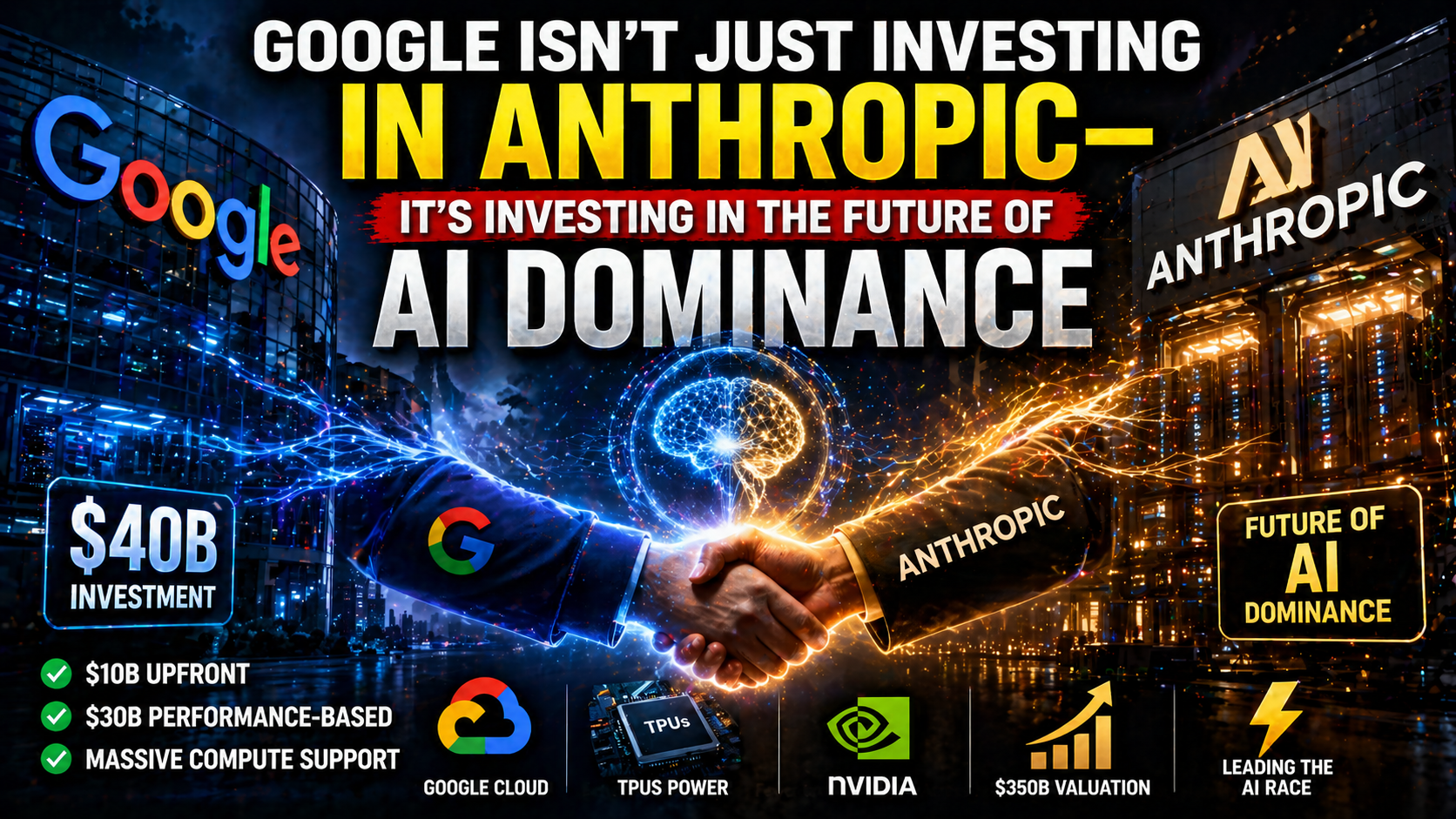
Google plans to invest up to $40B in Anthropic. Here's why this is not just funding — it's a strategic infrastructure move that reveals who is winning the AI race and how compute is becoming the new oil.
- Total investment: up to $40 billion ($10B upfront + $30B performance-linked)
- Anthropic valuation: approximately $350 billion
- Amazon also invested: $5 billion with long-term compute deal
- CoreWeave data center partnership: multi-billion dollar deal
- Anthropic exploring: IPO at potentially higher valuation
Google Is Not Just Investing in Anthropic — It Is Investing in the Future of AI Dominance
When a number like $40 billion appears in a headline, the instinct is to focus on the size of the cheque. That instinct misses the point entirely.
The amount matters, but it is the least interesting thing about Google's planned investment in Anthropic. What is interesting — and what the AI industry should be paying very careful attention to — is what this deal reveals about how Google understands the AI race, what Anthropic is building, and why the next decade of artificial intelligence will be decided by infrastructure and compute access more than by any individual model breakthrough.
This is not a funding round. It is a strategic power move. And understanding it as such changes what you see when you look at it.
The Deal Structure: More Than a Number
The $40 billion investment is structured in two parts: $10 billion upfront, with a further $30 billion tied to performance milestones. This structure is significant because it means Google is not simply writing a large cheque and hoping for the best — it is making a conditional commitment that scales with Anthropic's execution.
At the reported valuation of approximately $350 billion, Anthropic is being priced not as a software company generating current revenue, but as a platform company whose future importance to AI development justifies an extraordinarily high current valuation. Investor interest in Anthropic is reportedly growing, with an IPO being actively considered at a valuation that could be significantly higher than current figures.
The deal puts Google alongside Amazon — which has made its own $5 billion investment with a long-term compute commitment — as Anthropic's primary infrastructure and capital partners. The fact that Anthropic has secured massive commitments from two of the world's largest cloud providers is itself a signal about what kind of company Anthropic is becoming.
Compute Is the New Oil — And Google Controls the Refinery
To understand why Google's investment in Anthropic makes strategic sense, you need to start with the most important constraint in AI development: compute.
Training the frontier AI models that produce the kind of capabilities Anthropic's Claude represents requires access to enormous quantities of specialized computing hardware — primarily high-end GPUs and AI-specific accelerators — running continuously for weeks or months at a time. Inference — the process of actually using those trained models to respond to queries — requires ongoing, significant compute at the scale that Anthropic's millions of users generate.
Compute is genuinely scarce relative to demand. The waiting lists for NVIDIA's most advanced chips have stretched to months or years. Data centers capable of housing the hardware required for frontier AI training take years to build and billions of dollars to construct. Energy infrastructure to power them is becoming a limiting factor in many markets.
In this environment, the organizations that control access to compute have structural power over the pace of AI development. They can determine who gets to train models, at what speed, and with what regularity. This is not a temporary bottleneck that will resolve quickly — the capital requirements and construction timelines for data center infrastructure mean that compute scarcity will be a feature of the AI landscape for years.
Google, through its Google Cloud platform, controls significant data center and compute infrastructure. Its investment in Anthropic is partly a bet on Anthropic's model capabilities — and partly a mechanism for ensuring that Anthropic's enormous compute needs flow through Google's infrastructure.
Mythos: Anthropic's Most Powerful Model Yet
Anthropic is reportedly developing a model internally referred to as Mythos — described as its most powerful AI system to date, with particularly strong capabilities in cybersecurity applications. The model has been in limited release due to safety concerns, reflecting Anthropic's consistent position that capability advances need to be evaluated carefully before broad deployment.
The reported cybersecurity capabilities are worth noting specifically. AI systems capable of sophisticated reasoning about security vulnerabilities, attack vectors, and defensive measures represent both significant potential value for enterprise security customers and significant potential for misuse. Anthropic's decision to limit release while safety evaluation continues is consistent with its stated mission but also reflects the genuine difficulty of deploying powerful capabilities responsibly.
Early leaks of information about Mythos — before official controlled releases — suggest that information about frontier AI capabilities spreads quickly regardless of deployment decisions, creating a category of challenge that Anthropic and other frontier labs will need to navigate carefully as their models become more capable.
The Infrastructure Arms Race Anthropic Is Running
Google's investment is the largest single commitment to Anthropic's infrastructure, but it is one piece of a broader pattern of Anthropic securing compute access at a scale commensurate with its ambitions.
The company has a significant deal with CoreWeave for dedicated data center capacity. Amazon's $5 billion investment comes with a long-term compute commitment through AWS. Partnerships with Nvidia ensure access to the latest GPU generations. A partnership with Google and Broadcom for multi-gigawatt compute capacity — expected to expand further over the next five years — positions Anthropic to scale its infrastructure in line with model capability advances.
The pattern is consistent with a company that has understood a fundamental truth about frontier AI development: model capability advances are necessary but not sufficient. The infrastructure to train and deploy increasingly capable models must be secured in advance, because the timelines involved in building or contracting for data center capacity are measured in years, not months. Companies that try to secure infrastructure after they need it will always be behind companies that secured it before.
Anthropic's current constraint — Claude usage limits for some customers due to infrastructure capacity — illustrates the cost of operating at the frontier of demand. The infrastructure investments being made now are designed to eliminate that constraint as scale continues to grow.
Google's Dual Role: Competitor and Infrastructure Provider
The most strategically interesting aspect of Google's position in the Anthropic deal is the inherent tension in Google's dual role. Google is simultaneously a direct competitor to Anthropic — its Gemini models compete with Claude in the enterprise AI market — and Anthropic's primary cloud infrastructure provider through Google Cloud.
This is not a contradiction. It is a deliberate strategic positioning that reflects how Google is thinking about where value will accrue in the AI ecosystem.
Google understands that in any major platform transition, the infrastructure layer tends to generate more durable and larger revenue than the application layer. Cloud computing is the clearest recent precedent — AWS, Google Cloud, and Azure generated enormous revenue serving companies that were sometimes direct competitors in other markets. The same dynamic appears to be playing out in AI infrastructure.
By providing compute infrastructure to Anthropic — even as Gemini competes with Claude — Google ensures that its cloud business benefits from Anthropic's growth regardless of which AI model wins the capability race in any particular time period. Google gets paid whether its own models or Anthropic's models are winning the preference of any given enterprise customer, as long as both are running on Google Cloud.
This is a structurally more defensible position than betting entirely on model-level competition, which is inherently unpredictable and depends on maintaining research and capability advantages that competitors are constantly working to close.
The TPU Advantage: Owning the Chip Supply
Google's investment in Anthropic also comes with a specific hardware dimension that is worth examining. Google has developed its own AI accelerator chips — Tensor Processing Units, or TPUs — as an alternative to NVIDIA's GPUs. These chips are specifically optimized for the kind of matrix multiplication operations that underpin AI model training and inference.
By making TPUs available to Anthropic as part of their cloud relationship, Google offers Anthropic an alternative to the NVIDIA supply chain that every other AI lab is competing for simultaneously. This reduces Anthropic's dependence on NVIDIA's constrained production capacity and gives Google a differentiating factor in its cloud relationship with Anthropic beyond standard compute pricing.
For Anthropic, access to TPUs alongside GPU capacity provides flexibility to optimize different workloads on different hardware architectures — a meaningful operational advantage as the company scales. For Google, it creates a deeper integration between Anthropic's infrastructure decisions and Google's hardware ecosystem, making the relationship stickier and more valuable over time.
OpenAI's Parallel Infrastructure Race
The Google-Anthropic infrastructure relationship does not exist in isolation — it is part of a broader pattern across the AI industry where frontier labs are securing massive compute commitments as a strategic priority alongside model development.
OpenAI has been pursuing analogous infrastructure deals, securing commitments from Microsoft's Azure infrastructure, building dedicated compute arrangements, and pursuing its own data center investments. The specific mechanisms differ from Anthropic's approach, but the underlying logic is identical: frontier AI development requires infrastructure at a scale that cannot be assembled on short notice, so securing it in advance is a strategic necessity.
The AI race is becoming increasingly capital-intensive and resource-driven. The era when a small team of researchers with access to standard cloud computing could produce frontier results is ending. The bar for compute access required to stay at the frontier is rising with each generation of models, and the organizations that cannot secure sufficient infrastructure will find themselves unable to compete at the highest level regardless of their research talent.
AI Companies Are Becoming Infrastructure Companies
The Google-Anthropic deal reflects a transformation in what AI companies are. When Anthropic was founded, it was primarily a research organization — a group of safety-focused AI researchers building and studying large language models. Three years later, it is something qualitatively different.
Anthropic is becoming an infrastructure company. It is negotiating multi-gigawatt compute capacity deals. It is managing data center relationships across multiple major cloud providers. It is thinking about energy infrastructure, chip supply chains, and the capital structures required to sustain years of high-cost infrastructure investment before that investment generates sufficient revenue to be self-sustaining.
These are not the concerns of a software or research company. They are the concerns of a company operating at the intersection of AI capability development and physical infrastructure — a category that did not exist a decade ago and that is now absorbing some of the largest capital flows in the technology industry.
The same transformation is happening at OpenAI, at Meta's AI division, and at Google's own AI organization. The competitive landscape for frontier AI is not just a software competition or even a hardware competition. It is a competition for the ability to build, operate, and scale physical infrastructure at a level that matches the compute requirements of increasingly capable AI systems.
Future Outlook: The IPO and What Comes Next
With a current valuation of approximately $350 billion and growing investor interest, Anthropic's consideration of a public offering reflects confidence that public market investors will value the company at least at its current private market valuation — and potentially significantly higher.
The factors that would drive a higher IPO valuation are clear: continued improvement in Claude's capabilities, expansion of enterprise customer relationships, successful deployment of Mythos or next-generation models, and demonstrated ability to scale infrastructure to meet growing demand without the usage limits that currently constrain some customer access.
The risks are equally clear: the AI model landscape is competitive and fast-moving, infrastructure costs are high and take time to generate returns, and safety commitments that slow deployment could disadvantage Anthropic relative to competitors with less conservative release policies.
Whatever the IPO trajectory, the Google investment signals that at least one of the world's most sophisticated technology investors believes Anthropic will be a central player in AI for the foreseeable future — and that the infrastructure relationships being established now will be strategically important for years to come.
Bold Prediction
The companies that control compute will control AI. Not indefinitely — technology transitions always eventually produce new architectures that change the equation. But for the next five to seven years, the organizations that have secured the infrastructure to train and deploy frontier models at scale will have advantages that are genuinely difficult for late-movers to overcome. Google's investment in Anthropic is a bet on being on the right side of that advantage. Given the scale of the commitment and the strategic sophistication of how it is structured, it is a bet that deserves to be taken seriously.