The New Yorker Used AI Art — And It Sparked a Debate the Creative World Needed
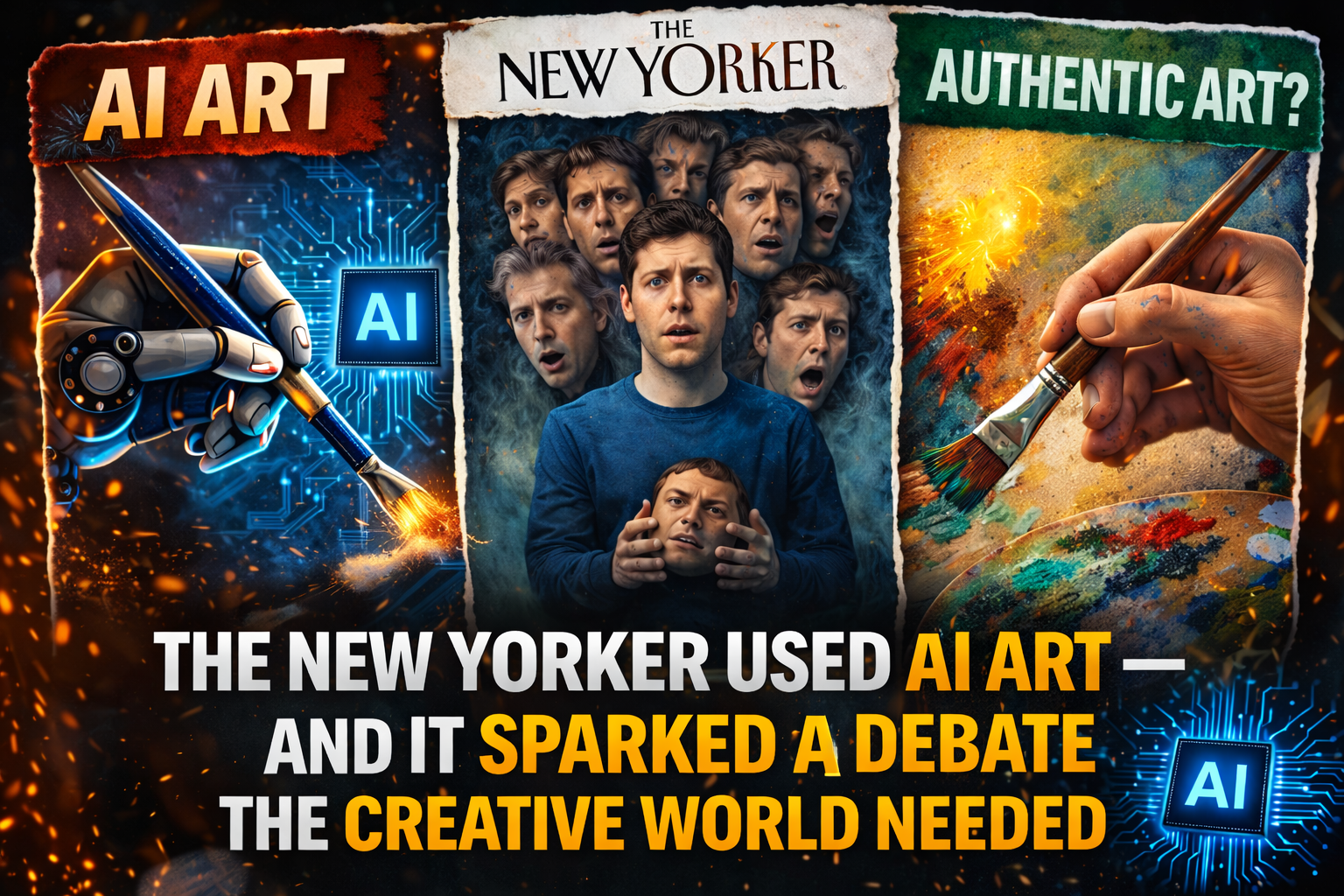
The New Yorker has published some of the most celebrated illustrations in the history of American media. Its covers are iconic. Its internal art is carefully chosen and deeply considered. When it decides to publish something visually, it matters. So when the magazine ran an AI-generated illustration alongside its recent profile of Sam Altman — complete with a small disclosure reading "Generated using A.I." — the creative world paid attention. And not everyone liked what they saw.
The Illustration: Eerie, Unsettling, Intentional
The artwork, created by artist David Szauder, features multiple distorted versions of Sam Altman's face. They are fragmented, overlapping, uncanny — the kind of image that makes you look twice and feel slightly uncomfortable.
That discomfort is the point.
The New Yorker profile is a critical piece. It questions Altman's trustworthiness, his motivations, and his leadership style. An illustration showing multiple distorted versions of his face — suggesting multiple personas, hidden depths, or a fractured identity — reinforces the article's central tension visually. Before a reader has processed a single word, the image has already told them something: this is a complicated man.
As editorial illustration, it is effective. As a creative choice, it is deliberate. And as a technological statement from a publication known for valuing human craftsmanship, it is genuinely surprising.
How the Artist Actually Made It
The reaction to "AI-generated art" is often immediate and dismissive — and in many cases, that dismissal is understandable. The internet is flooded with low-effort, generic AI imagery that lacks artistic intention and serves mainly to fill space cheaply.
Szauder's approach is meaningfully different.
He uses custom AI workflows — not a simple prompt typed into a consumer app. He combines archival material, including newspaper photographs and personal imagery, with traditional artistic techniques. The AI is one tool in a larger creative process, not a replacement for the process itself.
Think of it less like asking a machine to make a picture and more like a photographer using a darkroom. The darkroom does not make the photograph — the photographer does. But the tools shape what is possible and how the final image feels. Szauder's use of AI is similarly integrated into a human-driven creative vision.
That distinction matters. It does not resolve the ethical debate, but it should change how the debate is framed.
Why The New Yorker Is a Particularly Charged Venue for This
If a small digital publication had published an AI-generated illustration, the conversation would be different. Smaller outlets experimenting with new tools is expected and largely unremarkable.
The New Yorker is not a small digital publication.
It has a century of history and a reputation built partly on the quality of its visual art. It maintains a roster of world-class illustrators. Its covers are collectors' items. When The New Yorker makes a choice about what art to publish, it is not a casual decision — or at least it is not supposed to be.
For illustrators who have built careers contributing to publications like The New Yorker, seeing AI-generated work published there is not merely a philosophical concern. It is a signal about where the market is heading. If the most prestigious magazine in American journalism is willing to use AI-generated imagery, what does that say about the value those institutions place on human creative labour?
That concern is legitimate. It deserves a serious answer, not a dismissal.
The Case Against AI Art in Elite Publications
The strongest argument against using AI-generated art in publications like The New Yorker comes down to three things: authenticity, craft, and economic harm.
On authenticity: illustration in journalism is not purely decorative. It is an act of interpretation. A human illustrator reads the piece, understands its argument, and makes a series of creative decisions about how to represent that argument visually. That process involves taste, judgment, and a kind of empathy that comes from being a person who has lived in the world. AI does not have that. It has pattern recognition applied to vast amounts of human-created imagery.
On craft: illustration at the level The New Yorker has historically published represents years of skill development. It is not replicable instantly, and its value is partly in its difficulty. When AI can produce something that resembles the output of skilled work without any of the underlying skill, it challenges the assumption that craft has inherent value.
On economic harm: illustrators are already facing a difficult market. Editorial illustration budgets have been shrinking for years. If AI provides a cheaper alternative — even a sometimes inferior one — there is real risk that human illustrators lose work that sustains their careers. The concern is not abstract. It is financial and immediate.
The Case For: AI as a Legitimate Creative Medium
The counterargument begins with a question: what, exactly, is art?
Photography was once dismissed as mechanical reproduction rather than art. Digital illustration faced resistance when it replaced hand-drawn originals. Collage, sampling in music, found object sculpture — creative movements that use existing materials in new ways have always provoked debate about whether they constitute genuine creativity.
When AI is used thoughtfully — as Szauder uses it — it can create images that are genuinely experimental and that achieve effects impossible through traditional means. Multiple distorted faces of the same person, blended and fragmented in specific ways that reinforce a particular emotional message — that is not something easily achieved by a human illustrator working conventionally. The tool enabled something new.
If we accept digital collage as art, if we accept photography as art, if we accept any process in which a human makes a series of intentional creative decisions using available tools, then there is a logical case for accepting AI as a medium when used with genuine artistic intention.
The keyword is intention. The problem with most AI art is not that it uses AI. It is that it lacks intention. Generic prompts producing generic images in service of no particular creative vision — that is the "AI slop" that rightly draws criticism. Szauder's work, whatever you think of it, is not that.
Is Disclosure Enough?
The New Yorker included a disclosure: "Generated using A.I." Small, present, technically transparent.
Whether that constitutes adequate transparency is a genuine question. Most readers do not scrutinise publication credits. Most people who shared or discussed the illustration probably did not notice the disclosure. The information was technically available, but it was not meaningfully prominent.
As AI-generated content becomes more common in media — not just images but text, audio, and video — the question of what disclosure actually requires becomes increasingly important. A small credit line may not be sufficient. Readers arguably deserve to understand not just that AI was used, but how and why — particularly in a publication with The New Yorker's stated commitment to craft and authenticity.
What This Tells Us About Where Media Is Heading
The New Yorker is not alone in experimenting with AI visuals. Media organisations across the spectrum are testing AI tools for illustration, layout, and increasingly for writing. The economic pressure is real — smaller budgets, faster publication cycles, and audiences that consume content at a pace that is difficult to sustain with purely human-created material.
That does not make every AI application in media appropriate or inevitable. But it does mean the conversation needs to be specific rather than categorical. AI used as a shortcut to avoid paying illustrators is different from AI used as a creative tool by an artist with a clear vision. AI-generated filler content is different from AI used to achieve an editorial effect that serves the reader.
The creative industries are going to have to develop frameworks for making these distinctions — frameworks built on transparency, genuine artistic standards, and honest accounting of economic impacts on human creators.
The Uncomfortable Truth at the Centre of This Debate
Here is what makes this conversation genuinely difficult: the illustration worked. It was striking, appropriate to the subject, and editorially effective. If you did not know it was AI-generated, you might simply have admired it.
That effectiveness is precisely what makes the ethical questions urgent. If AI art were obviously inferior, the debate would resolve itself. The fact that it can be good — can be, in some cases, the right creative choice — means the creative industries cannot rely on quality alone to maintain the case for human artists.
The argument for human illustration is not just that humans make better art, though often they do. It is that the process of a person engaging seriously with a subject, bringing their own perspective and skill to represent it visually, has value in itself. It is that editorial illustration is a form of journalism — interpretation, not just decoration — and that interpretation should come from a human who can be held accountable for it.
Those arguments need to be made clearly and loudly. Because AI is not going away, and publications facing economic pressure will keep looking for ways to use it.
Key Takeaway
The question is not whether AI can make art. It clearly can. The question is what we lose — in craft, in authenticity, in economic support for human creativity — when institutions with the resources to commission human artists choose not to. That is a choice, not an inevitability.